Social robots constitute a significant component of therapeutic mediation tools used with children diagnosed with autism spectrum disorder (ASD). Predominantly anthropomorphic, these robots are designed to facilitate interaction by relying on the simplicity of their expressive modalities, achieved through simplified and predictable behaviors. Their interactional simplicity makes them particularly valuable tools for healthcare professionals. Numerous studies highlight their potential benefits in supporting joint attention, imitation, and emotion recognition. Are anthropomorphic robots, however, truly an adequate means of addressing children’s difficulties? In this article, we show that although the anthropomorphic approach currently dominates the field, it presents several limitations that must be addressed. These limitations concern the cost and accessibility of such devices, their acceptability among children and professionals, their limited adaptability to the situated practices of care, as well as the additional technological workload they impose on caregivers. Drawing on an examination of social robotics applied to autism and its limitations, this article proposes to broaden the scope of inquiry by considering a conception of the social that is not restricted to face-to-face interaction but instead encompasses its multiple dimensions. As with any technical object, the design of mediation robots is shaped by networks of human, institutional, and symbolic relations that determine their uses and their effects. Based on a review of the main existing devices and on fieldwork conducted with healthcare professionals, we identify two principal models of mediation. We argue that these models do not always align with care practices and with the situated forms of knowledge on which such practices rely. We propose to explore a complementary pathway in mediation robotics. This approach is being developed within the framework of the Médiations Robotiques en Soins de Santé (MR2S) project. It is grounded in the design of non-anthropomorphic, softer, simpler, and cheaper technical devices that build upon the experience of healthcare professionals. Our approach pays particular attention to an aspect that remains relatively unexplored in social robotics applied to autism: sensoriality. The purpose of the project is to design robotic objects capable of enriching the therapeutic relationship while being sustainably integrated into existing care practices.
Social robots were initially designed within frameworks of assistance, accompaniment, and relational support, particularly in contexts of ageing, care, and social isolation. Yet their diffusion has been accompanied by recurring concerns regarding loss of control, dehumanization of social relations, emotional dependency, human replacement, and the artificialization of care practices. Drawing on an analysis of media discourses devoted to social robots, this article proposes to shift the conventional question of technological acceptability toward an anthropology of contemporary relational imaginaries. The central hypothesis advanced here is that controversies surrounding social robots do not merely reveal resistance to technological innovation; rather, they make visible a deeper crisis affecting social bonds, care infrastructures, and forms of human presence. Media representations thus emerge as privileged sites of symbolic production where the boundaries between human and non-human, assistance and substitution, relationship and simulation are continuously negotiated. The article argues that the acceptability of social robots cannot be reduced to functional evaluation alone but must instead be understood as a cultural and anthropological construction of technical alterity and human–machine relations.
Research on artificial intelligence and robotics has long been structured by questions of autonomy, cognition, and embodiment. Whether in engineering, cognitive science, or philosophy of mind, the dominant concern has been how machines can perceive, act, and interact within their environments. This article argues that such perspectives are no longer sufficient to account for the contemporary transformations associated with intelligent technologies. The central claim advanced here is that the key issue is not machine autonomy but social incorporation. Robots and AI systems become socially significant not because they increasingly resemble humans, but because they are progressively integrated into networks of practices, institutions, and forms of life that incorporate them into collective action. Contemporary robotization should therefore be understood less as a technological evolution than as a reconfiguration of social regimes of delegation. Drawing on socio-semiotics and Science and Technology Studies (STS), the article develops a theoretical framework that distinguishes three interconnected forms of delegation: operational delegation, cognitive delegation, and decision-making delegation. Through these processes, intelligent technologies increasingly participate in the production of action, interpretation, evaluation, and choice. As a result, agency and responsibility become distributed across complex assemblages involving humans, algorithms, sensors, infrastructures, and organizations. The article further examines contemporary warfare as the most visible and radical manifestation of these dynamics. Autonomous drones, AI-assisted targeting systems, and automated command platforms reveal how mechanisms of delegation extend beyond technical assistance and increasingly shape processes of identification, classification, and decision-making. Far from being confined to the military sphere, these transformations illuminate broader changes affecting healthcare, logistics, security, and everyday life. Building on these observations, the article proposes the foundations of a geosemiotics of robotization, understood as an analytical framework capable of articulating sociotechnical imaginaries, social practices, infrastructures, and geopolitical power relations. From this perspective, the fundamental challenge posed by intelligent technologies in the twenty-first century is not the replacement of humans by machines, but the ongoing reconfiguration of action, decision-making, and responsibility within hybrid collectives composed of human and nonhuman actors.
This study proposes an anthroposemiotic theory of prehistoric writing, moving beyond the traditional view that script emerged purely from administrative needs in early Mesopotamian civilizations. Instead, it intends to demonstrate that writing’s deepest roots may lie within the graphic and ritual practices of the Upper Palaeolithic. Approaching early humanity as Homo symbolicus, this study explores how cave art, geometric signs, and monumental architecture may have functioned as exosomatic memory and sacred mediation. Drawing on archi-écriture and spatial syntax, the research shows that prehistoric marks organized spatial relations and structured symbolic ecosystems long before their formalization into phonetic scripts. Ultimately, writing’s genesis can be situated within a broader cognitive evolution, where symbolic exteriorization transformed natural surfaces into durable spaces of meaning.
This research focuses on meaning-making discourses developed by Master’s 2 students within private higher education institutions. Based on a qualitative approach grounded in semi-structured interviews and reflexive fieldwork, the study analyses how university communication devices contribute to the production and narration of student trajectories. The findings highlight a strong capacity among students to articulate their aspirations, doubts and professional projects. Far from being the spontaneous expression of individual interiority, these discourses also appear as the product of institutional frameworks that encourage reflexivity and self-presentation. Drawing on the works of Erving Goffman, Pascal Lardellier and Hartmut Rosa, the article shows how pedagogical interactions, academic rituals and support mechanisms contribute to the construction of meaning in student trajectories. This reflection leads to questioning the limits of institutionalised reflexivity and to emphasising the importance of the mediation of interactions and relational resonance in renewing social ties within higher education.
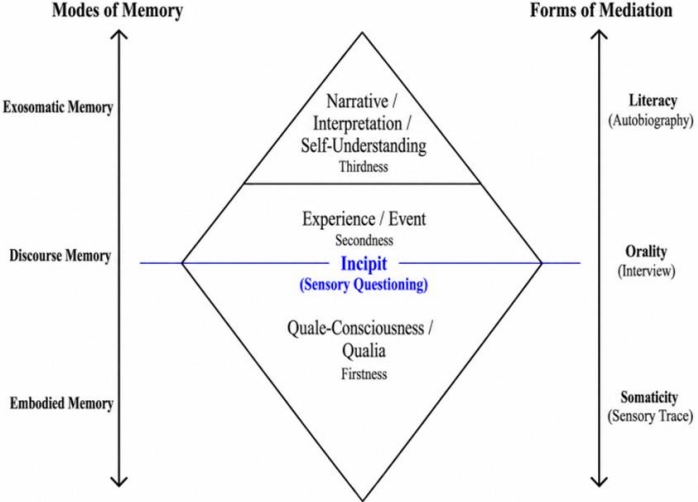
This paper argues that the silence of the elderly does not indicate memory loss; rather, it may be the threshold of memories that have not yet found their voice. The study proposes the concept of “Memory Incipit” as a theoretical framework, based on Charles Sanders Peirce’s concepts of qualia and quale-consciousness. This concept delineates the moment prelinguistic embodied memory first becomes speech through silence, hesitation, fragmentary utterances, repetition, and place-related words. Using a series of autobiographical interviews conducted with five low-income elderly individuals, this study reveals that their memories frequently manifest not as chronological events or causal narratives, but rather as bodily sensations, the atmosphere of a place, and sensory and emotional traces condensed within brief utterances. Sensory questions facilitate the translation of these traces into verbal expression. Therefore, incoherent speech and fragmented utterances do not signify failures in the act of narration. Rather, they represent the initial phase in meaning-making whereby embodied memory becomes speech. The study aims to explore the potential of “Memory Incipit” as a framework for understanding the narrative identity of older adults with limited literacy and opportunities for self-narration.
This article offers a cross-reading of Jerome Bruner’s narrative intelligence and the narrative identity of Boris Cyrulnik and Paul Ricoeur to grasp the self-narrative on Discord. Drawing on fifteen interviews conducted within a Weberian interpretive framework, it shows how the interface generates a sense of a ‘‘ blank page’’ that licenses identity experimentation, omission, and confiding without fear of consequences. The body, and the voice in particular, nonetheless recalls the subject to temporal coherence. Between the lightness of the ephemeral bond and the maintenance of self through the Ricoeurian promise, the online self-narrative articulates sameness and selfhood, revealing the platform as a social circle in its own right.
The teaching of French as a foreign language (FLE) and intercultural studies represents a fertile field of research for educational theorists and researchers. As a result, teachers have access to a wide range of teaching resources (both online and in print, such as textbooks). This paper examines how cultural representations are depicted in FLE textbooks published in France. Textbooks serve as the backbone of a lesson, and they are widely used by teachers. In this article, we will focus on the Alter Ego+ and Mon Alter ego textbooks for levels A1–A2, published by Éditions Hachette and used not only in France but also in many other countries. We will conduct a qualitative study of cultural representations specific to France, as well as of lessons dedicated to literature in FLE textbooks.





 First
First Prev
Prev