Abstract
This paper argues that the silence of the elderly does not indicate memory loss; rather, it may be the threshold of memories that have not yet found their voice. The study proposes the concept of “Memory Incipit” as a theoretical framework, based on Charles Sanders Peirce’s concepts of qualia and quale-consciousness. This concept delineates the moment prelinguistic embodied memory first becomes speech through silence, hesitation, fragmentary utterances, repetition, and place-related words. Using a series of autobiographical interviews conducted with five low-income elderly individuals, this study reveals that their memories frequently manifest not as chronological events or causal narratives, but rather as bodily sensations, the atmosphere of a place, and sensory and emotional traces condensed within brief utterances. Sensory questions facilitate the translation of these traces into verbal expression. Therefore, incoherent speech and fragmented utterances do not signify failures in the act of narration. Rather, they represent the initial phase in meaning-making whereby embodied memory becomes speech. The study aims to explore the potential of “Memory Incipit” as a framework for understanding the narrative identity of older adults with limited literacy and opportunities for self-narration.
-
Keywords: Memory Incipit, qualia, quale-consciousness, embodied memory, narrative, autobiography, low-income older adults
1. Introduction
The crux of elderly narratives lies not in determining the point of departure, but in ascertaining how the story can commence. Questions that focus on events, such as “How old were you at the time?” “What happened then?” and “How did you feel?” (
Birren & Deutchman, 1991), require elderly individuals to organize their past experiences into a sequential and causal structure. However, the memories of older adults do not initially emerge as a clear arrangement of events, people, causes, and effects. Instead, these phenomena often manifest initially without verbal articulation and repetition, characterized by the juxtaposition of disparate sensory experiences, the ambience of a specific locale, and an inexpressible emotional intensity.
At this juncture, we must acknowledge the seminal contributions of Charles Sanders Peirce, particularly his conceptualizations of “qualia” and “quale-consciousness.” These theoretical insights offer a crucial framework for comprehending the memories of older adults. Qualia are defined as the qualitative characteristics of subjective experience that cannot be fully reduced to objective language or concepts (
Peirce, 1960, CP 1.555, p. 294). According to Peirce, these qualitative experiences are linked to the dimension of “Firstness,” namely, the state of pure sensation that precedes any relationship with others or linguistic interpretation (
Peirce, 1960, CP 3.424, p. 265). These phenomena are defined by a state of quale-consciousness, which is characterized by an indescribable sensory quality and emotional mass. This state is transient and subject to formalization into specific words or sentences. A similar phenomenon has been observed in the case of elderly individuals, whose memory often exhibits a similar pattern. This phenomenon approaches a state of quale-consciousness, characterized by an indescribable sensory quality and emotional mass that precedes its formalization into specific words or sentences.
Consequently, the absence of a verbal response or the use of non-verbal cues, such as averted eyes or evasive gestures, exhibited by elderly individuals when confronted with inquiries, should not be construed as indicative of memory impairment or an inability to provide a definitive response. This is because such responses do not necessarily indicate a deficiency; they may be a condensed expression of the texture of the memory that has not yet been organized into a causal narrative. If an analogy is to be drawn between the memory of an elderly person and a vast ocean, it may be posited that the former is not merely composed of fragments of individual events. Rather, it is characterized by a complex interweaving of sensations, images, emotions, and traces of places, all of which are subject to constant flux. In other words, the memory of an elderly person can be considered less of a standardized repository of events and more akin to an ocean of life, in which diverse qualitative layers have settled in successive strata (
Conway, 1996, p. 67).
This phenomenon is particularly salient among low-income individuals or elderly people with low literacy levels, with memories often residing more deeply on a sensory and physical level than in logical, linguistic narratives. The phenomenon of memories resurfacing in the form of fragmented images or sensations, as opposed to being articulated in coherent sentences, does not signify an absence of memory. Rather, it is indicative of memories residing in a realm that predates the development of language. For those who have been marginalized from formal institutional education and opportunities for social expression, the history of their lives may be preserved not as a chronological narrative, but as a knot of sensations and emotions etched into their bodies.
The application of the concept of qualia to the oral narratives of older adults facilitates a different interpretation of their fragmented utterances and silences. This phenomenon does not stem from a dearth of or breakdown in narrative; rather, it indicates a state in which memories of sensory and emotional experiences have not yet been thoroughly organized into coherent verbal expressions. This perspective is pivotal in grasping the complexity and depth of older adults’ utterances, which might otherwise appear fragmentary. In this regard, the concept of qualia plays a pivotal role in the study of elderly narratives, particularly in the context of oral life history research among low-income elderly individuals who face challenges in articulating their lives through institutional language and chronological narratives.
The study’s objective is to elucidate how the autobiographical memories of low-income older adults exist in a pre-narrative, qualitative state and through what questions and mediations they emerge to the surface of consciousness. The study focuses on the moment when embodied memories — which had remained at the level of quale-consciousness and qualia — begin to take shape and are verbalized, through the interview questions. This study conceptualizes said moment and point as “Memory Incipit (MI).” In this context, Memory Incipit (MI) signifies the initial emergence of the pre-linguistic qualitative memory into the realm of consciousness through the process of questioning, which initiates its transformation into verbalized memory through the sensory attributes of qualia.
Consequently, as opposed to the examination of the entire process of autobiographical writing among low-income older adults, this study analyses the preceding stage — specifically, the initial transition at which embodied memories emerge as oral memories through questioning. To this end, the study draws on Peirce’s concepts of primacy, qualia, and quale-consciousness as the theoretical foundation, and it examines how questions centered on place and sensation evoke memories in low-income older adults and facilitate their articulation.
2. Materials and Methodology
In the preceding chapter, the term “MI” has been defined as the point at which the embodied memories of low-income older adults rise to the surface of consciousness through interview questions and begin to transform into oral memories. This chapter details the methodology employed in the selection of research participants, the nature of the data collected, and the design of the interview questions, with the aim of capturing the prevailing sentiment at that particular moment.
2.1 Participants
The participants in this study are low-income elderly individuals living alone in an administrative district of a local government in the Seoul metropolitan area. For the purposes of this study, low-income elderly individuals living alone are defined as individuals aged 65 or older — the age criterion for the elderly under the Welfare of the Aged Act — and are limited to those confirmed to be living on public subsidies from the government, in single-person households.
While this study employs the administrative designation “elderly recipients of basic livelihood security benefits” as its point of departure, it does not perceive this designation to imply a single, uniform way of life or identity. Assuming that financial hardship necessarily hinders the organization of memories or the formation of a narrative identity is reductive. However, low-income elderly people living alone are likely to have limited opportunities to go out and socialize for reasons such as ageing, illness, mobility difficulties, and living conditions that rely on public benefits. Consequently, their opportunities to repeatedly recount their lives, receive responses, and narrativize their memories are reduced. Therefore, their memories are more likely to persist in the form of bodily sensations, the atmosphere of places, fragments of silence, and sporadic utterances, rather than being organized into chronological event narratives. This is particularly salient for elderly individuals with low literacy or limited opportunities for social discourse, in whom memories may be embedded more deeply in sensory and physical layers than in logical, linguistic narratives.
The researcher identified approximately 55 low-income elderly individuals living alone, who received public benefits and were served by the local administrative district’s elderly welfare services, as the potential study population. Participants who were unable to participate in in-depth interviews because of factors such as admission to a nursing home or long-term hospitalization were excluded from the study. Study participants were recruited primarily from among those who expressed interest in the autobiography-writing process and consented to the recording of interviews and the use of photographic materials.
2.2 Data and Interview Design
The data chiefly comprise oral accounts generated during autobiographical interviews with low-income elderly individuals living alone. The interviews were conducted between December 2025 and May 2026. Each participant completed one or two sessions, and each session lasted 30–60 minutes (
Riessman, 2007, p. 53). However, the duration and frequency of the interviews were subject to flexible adjustments to accommodate the participants’ fatigue levels, health conditions, and the extent of their ability to maintain concentration. Consequently, rather than adhering to a predetermined questionnaire within a stipulated time frame, the interviews were conducted based on the participants’ speaking pace, silences, hesitations, fatigue, and emotional responses, and the number of questions were reduced or breaks were taken as necessary.
In addition to oral accounts, we treated silences, hesitations, repetitions, fragmented utterances, descriptions of places, and sensations that emerged during the interview as important analytical data. The study also examined the photographs selected by participants for inclusion in their autobiographies, along with the discourse surrounding these images, as mediating scenes that evoked memories.
The study focuses on the specific moment during the process of writing elderly life stories when pre-linguistic memories are first recalled and verbalized through questioning, as opposed to addressing the writing process in its totality. Therefore, while the interviews were conducted using a semi-structured approach, the questions were designed not only to explore event-centered details, such as “when, where, and what happened,” but also to touch upon the textural and sensory aspects of memory through inquiries such as “what was the atmosphere like,” “how did your body feel at that moment,” and “what comes to mind.”
The questions posed to the participants were meticulously designed to elicit memories pertaining to their respective hometowns, current residences, and professional environments. These three domains, respectively, represent the lifeworld of the past, the space in which the subjects’ present lives unfold, and the places where they performed physical labor. The underlying rationale for the decision to organize the inquiries around the concept of place, instead of events, stems from the understanding that event-centered inquiries necessitate older adults to offer a chronological sequence and causal explanations. Conversely, place-centered questions do not require an immediate explanation of the memory; rather, they initiate a discussion by probing the sensory context associated with the memory. Therefore, place-centered questions have been shown to reduce the burden on older adults when accessing their memories and provide an entry point through which pre-linguistic sensory memories can lead to verbal expression.
For instance, in the event that a participant was unable to answer immediately or hesitated when asked, “What comes to mind when you think of your hometown?”, the researcher narrowed the focus of the question to a person — such as “Who is the first person you think of when you think of that place?” — rather than asking for a specific event. In the event of a positive response, the participant was asked to elaborate on the recalled image by providing a description. If the participant recollected “her sewing by candlelight at night,” the researcher would proceed by posing questions pertaining to the sensory texture of the scene, such as “What kind of feeling does that scene evoke for you?” The question of whether the sensation was one of warmth or isolation was posed. In addition, the recollection of the light, smell, or sounds present in the room at the time was requested.
The purpose of such questioning is to avoid insisting that memories be presented as fully formed narratives from the outset. Memories in low-income elderly individuals often emerge first through specific places, people, bodily sensations, and recurring images, rather than through linear narratives such as “something happened in such-and-such a year.” Therefore, the objective of the interviews conducted for this study was not limited to confirming the chronological sequence of events. Instead, by using follow-up questions that progressed sequentially from place to person, from person to scene, and from scene to sensation and emotion, the researchers sought to capture the process by which memories from the pre-linguistic period transformed into a form that could be articulated.
2.3 Research Focus: Mediation as the Surface
It is crucial to note that traces require a surface. The act of writing can be defined as the process of applying ink to a surface, such as paper, thereby leaving a visible mark. Conversely, photography can be understood as the process of capturing light and subsequently printing or digitally storing the image on photographic paper or a digital medium. Footprints on the ground, whether in dirt or snow, and wounds on the skin, both indicate recent activity. The absence of a surface results in the inability of traces to linger; consequently, the perception of the past becomes challenging. The question therefore arises regarding the location of these memory traces. Of particular interest is the question of the location of these memories in the elderly, which are often inexpressible in words or writing. The author does not subscribe to the notion that the memories of the elderly are preserved solely within written text or complete narratives. The memories of the elderly are hypothesized to persist as traces on various surfaces: the sensations of the body, the atmosphere of a place, photographic images, objects, smells, sounds, silence, and repeated words. The issue pertains to the inherent difficulty in locating these traces.
The process of producing an autobiography for the elderly can be defined as the transfer of these invisible traces, etched into the body and mind, onto another medium. The process under discussion is one of mediation, in which traces of memory — remaining on the body, in places, in photographs, in objects, in silence, and in fragmentary utterances — are evoked(
Casey, 1993, p.103) through questions and transcribed into text through oral narration. This is particularly evident in the case of older adults who have low literacy levels. In this context, autobiographical writing can be considered less of a solitary, individual act of writing and more of a collaborative process of evoking, verifying, and adjusting memories (
Kenyon, Bohlmeijer, & Randall, 2011). This is because it is shaped within a relationship with the researcher.
The autobiography-writing process comprised the following steps: interviews, photo selection, recording, transcription, and review and revision. During the in-depth interviews with the researcher, the participants were invited to recount their lives and select the photographs and scenes they wished to include in their autobiographies. The recorded oral accounts were transcribed into text, and the transcribed content was then presented to the participants. Participants who demonstrated proficiency in reading reviewed their own statements in written form, while those who exhibited challenges with reading performed the verification and revision process by means of a listening exercise, wherein the researcher read the text aloud. The verification and revision process is not merely a matter of editing or censorship. This process of interpretation involves participants revisiting their own words; determining what to retain, what to eliminate, what to supplement, and what to rephrase; and conducting a self-reflective examination to determine the authenticity of the narrative (
Thompson & Bornat, 2017, p. 238). Moreover, the written record constitutes a process of forming semantic traces that facilitate the interpretation of the subject’s life and memories, even without their physical presence (
Derrida, 2020, p. 178). It is significant in that it enables the elderly to confront and interpret their own lives anew. The following schema illustrates the proposed process of autobiographical writing.
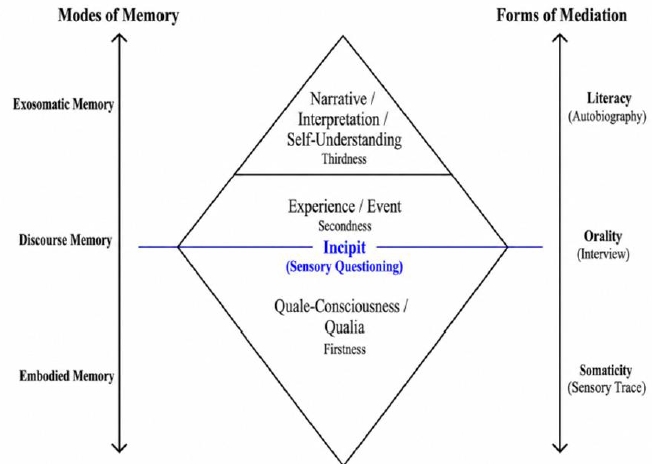
This study does not address the entire process of autobiographical writing, but rather the moment of “MI” — the point at which a memory first finds its voice within that process. This juncture marks the transition from embodied to discourse memory through the process of questioning, and it corresponds to the convergence point of Peirce's primary and secondary qualities. The study focuses on the initial formation of memory, employing sensory-centered inquiries such as “What was the atmosphere like there?” “How did your body feel at that time?” and “What smells or sounds remain?” instead of event-centered questions that inquire “When, where, and what happened?”
This point is indicated by the blue line in the center of the diagram. In this context, questions are not merely instruments for the acquisition of information. Instead, questions are a medium that facilitates the emergence of embodied memories at the quale-consciousness level, enabling them to manifest within the conscious mind. In other words, questions represent the point of contact at which memories that have not yet been organized into events or sentences initially manifest in the domain of oral expression. The “surface of memory” being referred to is not an independent entity, but rather a metaphorical point of contact at which pre-linguistic, qualitative memories begin to emerge into the dimensions of consciousness and oral expression. It is posited that beneath this superficial layer, there exist embodied memories that persist in the form of bodily sensations, the atmosphere of a given place, photographic images, olfactory sensations, auditory stimuli, and emotional density. The act of posing a question does not serve to revive or create anew a particular memory; rather, it serves to gently stir or awaken the latent memories already present within the body, the environment, and the senses.
The concept of “MI” signifies the precise moment of transition that occurs at this juncture. If the surface of memory is compared to a body of water, then the incipit can be understood as the moment when a memory beneath the surface first becomes visible. In other words, the incipit of memory refers to the moment when an embodied memory rises to the surface of consciousness through questioning and begins to transform into an oral memory expressed through silence, repetition, fragmentary utterances, and descriptions of places and sensations. The study aims to analyze this precise moment of transition.
3. Theoretical Framework
3.1 Beneath the Surface: Qualia and Quale-Consciousness
The fundamental question under consideration is whether memories are inherently linguistic phenomena from the outset. When recalling the past, do memories manifest initially as sentences or as scenes, sensations, and feelings? When attempting to recollect a previous residence, the initial thought that manifests may not be the specific year in which we inhabited the property. Instead, it is the light that entered the room, the musty smell, the atmosphere that was both comforting and lonely, the sound of someone’s voice, and the vague mood that pervaded the space. The hypothesis that memories are not organized into language but remain as various feelings and sensory images prior to being verbalized is more plausible (Damasio, 2021, p. 5).
Peirce’s concept of qualia facilitates comprehension of this point from multiple perspectives. Peirce explains the notion of qualia as follows:
1. “In so far as qualia can be said to have anything in common, that which belongs to one and all is unity.” (Peirce, 1960, CP 6.226, p. 151)
2. “The function of conceptions is to reduce the manifold of sensuous impressions to unity.” (Peirce, 1960, CP 1.545, p. 287)
The fundamental premise is that qualia do not merely constitute an aggregation of dispersed sensations. Qualia are defined as qualitative sensations, including but not limited to coldness, darkness, numbness, warmth, and strangeness. However, it is important to note that these sensations do not exist solely as completely separate fragments. As Peirce observes, the defining characteristic of qualia is “unity.” (
Peirce, 1974, CP 6.226, p. 151). In other words, while individual sensations can be distinguished from one another, they are felt together as a single, unified atmosphere within the actual experience.
Furthermore, Perth links this qualitative experience to “quale-consciousness” and explains it using a metaphor of a composite photograph.
3. “The quality itself is nothing in the world but a quale-consciousness of a composite photograph or general average of experience.” (Peirce, 1960, CP 6.232, p. 153)
The “composite photograph” to which Perth refers appears to be a single image, yet it is composed of multiple scenes and experiences that have been layered within it. In order to elucidate the concept of memory through this metaphor, a quale must be defined as a single qualitative sensation that constitutes the composite photograph of memory. Furthermore, qualia can be understood as the layers of sensation formed by these overlapping sensations. Finally, quale-consciousness is defined as the state in which these overlapping sensations are perceived as a single, holistic atmosphere before they are differentiated into language. This trace does not correspond to any concrete sensory object, such as sound, image, speech, or text. Instead, the fundamental condition itself is the determining factor (
Derrida, 2020, p. 177)..
If this memory is considered a composite image, then the memory of an elderly person can be viewed as a composite, multi-layered image. This phenomenon can be attributed to the fact that, while the memory of a child is primarily based on relatively short-term experiences, that of an elderly person is characterized by the presence of deep layers that have been formed by the accumulation and repetition of life’s sensations over an extended period. The following summary is offered of Peirce’s concepts and metaphors when applied to the example of an elderly person’s memory.
3.2 Memory on the Surface: Where Qualia Meet Orality
Qualia belong to the realm of primaryness described by Peirce. The study contends that, in contradistinction to the semiotic and interpretive order of tertiaryness that is frequently emphasized, the layer of primaryness — where memory persists in sensory and emotional form — is more fundamental to understanding the narratives of the elderly (
Misak, 2004, p. 84). The following discussion will consider a classroom from the first year of elementary school. When one attempts to recall a classroom, it is not merely a simple image that comes to mind, but rather a variety of sensations, emotions, and other elements that arise in unison. Conversely, the interviewer’s questions serve to temporalize space, gradually unravelling the memories that were multilayered and condensed within this image over time (
Derrida, 2020, p. 177). MI emerges from the interplay between two forces: the simultaneity of memory seeking to condense and the sequential nature of language seeking to unravel. In the preceding section, the elderly person’s memory was described as “Quale-consciousness” — a composite photograph in which various qualitative sensations are superimposed. Within this environment, sensory experiences, such as cold, smell, light, physical fatigue, voices, and emotions, are not distributed randomly but rather coalesce into a unified atmosphere (
Peirce, 1974, CP 6.223, p. 150). If this is indeed the mode of a memory that lies beneath the surface, then oral narration can be considered the method by which this condensed memory is unraveled individually within the sequence of speech.
Memories are experienced as a sudden rush, yet words are articulated individually. The interviewer is unable to pose multiple questions simultaneously, and the elderly individual cannot recollect all their memories instantaneously. The process of inquiry and response occurs sequentially, with each question being posed and subsequently followed by its corresponding answer. This phenomenon can be attributed to the sequential nature of language. Memories that remain in their primary state are hypothesized to be fused together like a single image. However, the interviewer uses questions to segment and arrange the events sequentially. Therefore, it can be concluded that oral narration functions as a mediating process, whereby the qualitative memories in their primary state, which had remained beneath the surface of consciousness, are externalized through speech.
To illustrate this point, consider the following example: if an elderly individual is asked about their hometown, they may respond inaccurately because of their limited knowledge of the subject. The notion of the hometown of some 70 years ago is not merely a matter of administrative information, but rather a concept that carries significant socio-cultural implications. It does not merely refer to the region where one was born and lived. The notion of a hometown is often associated with a specific sensory experience, including the olfactory impression of soil, the coldness of a winter morning, the maternal voice, the pervasive sense of economic disadvantage, the illumination found in the alleyways, the physical exhaustion of a child, and a combination of longing and sorrow. However, this multi-layered, complex image cannot emerge through oral narration alone. The words “It was cold” might be recalled first, followed by “It smelled of earth,” “I remember my mother’s voice,” and “I was hungry back then.” This process can be conceptualized as a form of mediation.
The fundamental premise is that speech does not spontaneously generate memories. The existence of underlying reasons and contexts for these feelings is already apparent. Simply put, at the qualia level, the cold, the smell, the voices, the fatigue, and the sorrow were all congealed into a single atmosphere. This resulted in the reasons seeming undifferentiated . Oral narration is a process by which this congealed qualitative image is unraveled, piece by piece, within the sequence of words. In this manner, queries such as “For what reason does that dwelling persist in my recollection as a frigid locale?” and “For what reason do sentiments of nostalgia and melancholy coalesce when I reflect upon my place of origin?” progressively interconnect with specific scenes and occurrences.
Therefore, verbalization does not correspond to the initial moment of memory formation; rather, it is how a memory that is already embedded in the body and senses assumes a clearer form. If a memory is represented by a blurry composite photograph, then oral narration can be considered an enhancement of that image’s resolution. The initial impression of a vague atmosphere is then broken down into its constituent elements through questions and speech, and these elements are subsequently woven back together into a single narrative. In this sense, oral narration can be considered both the deconstruction and the clarification of memory; it is how embodied memory is transformed into a narrated experience.
At this juncture, the distinction between Peirce’s primary and secondary qualities becomes evident. The primary qualities constitute a dimension of qualitative sensation that has not yet been differentiated into objects, causes, events, or judgments. Rather than being a “sensation of something,” it is closer to the sensation itself, which is given first. In the case of the aforementioned elderly gentleman, the primary order manifests as a series of qualitative sensations, including, but not limited to, cold, smell, darkness, a sense of heaviness, physical fatigue, and the atmosphere of a given place. This memory has not yet manifested as an event. In other words, it has not yet been defined in terms of time, place, and specific occurrence. The phenomenon under discussion can be considered to remain at the level of a qualitative state prior to the development of language, that is, at the pre-linguistic qualia level
In contrast, the second-order realm constitutes the dimension of real-world contact, encompassing encounters with, collisions with, and experiences of resistance from external entities (
Short, 2007, p. 86). The emergence of the second-order realm is characterized by the establishment of a connection between a pure sensation and a particular object, location, body, or event (
Peirce, 1960, CP 1.545, p. 287). For instance, when the sensation of “being cold” remains as a simple feeling of coldness, it is close to a first-order qualitative memory. However, when an elderly individual makes a statement such as “That house was cold,” the sensation of coldness is associated with a particular house, a specific time, and the experience of a particular body. At this point, the qualitative sensation transitions into the domain of actual experience. This is precisely the boundary where primary and secondary modes meet.
The distinction between image and speech and the transition from the former to the latter are not merely a matter of expression. This is a period of transformation, in which qualitative memories that predate language are gradually differentiated through questioning and, concomitantly, established as new forms of experience. The term “MI” employed in this study denotes this precise moment, this specific point in time. In other words, MI is the point at which an embodied memory, which has been condensed like a composite photograph, begins to transform into a memory that is first articulated through questions and speech.
In this sense, MI may be considered a moment of construction through deconstruction. The act of oral narration serves to disaggregate the memories that have been consolidated into layers of qualia, thereby facilitating their individual examination. However, this process does not entail the mere recollection of memories; rather, it is an endeavor to articulate and construct experiences through the medium of language, thereby facilitating their recognition and interpretation. Before words can form shape, sensations such as cold, olfactory impressions, voices, fatigue, and sorrow — which had been amalgamated into a unified atmosphere — are interconnected with specific scenes and events through the medium of interrogation and discourse. Memories do not simply disappear when deconstructed; rather, through this process, they are reconstituted into more precise experiences and events.
4. Analysis
4.1 The Memory Incipit: Silence, Fragment, and Place
The concept entitled “MI” is akin to a door. A door is defined as a barrier that separates the internal from the external environment. However, it also functions as a means of access, which can be either closed or opened. When a door is closed, it occludes the view of that which is contained within; however, when it is opened, the world inside begins to reveal itself to the outside. In this study, MI occupies precisely this position of a door. This state does not signify the emergence of a memory as a complete narrative, nor does it entail its complete submersion in silence. This liminal space functions as a critical juncture, determining whether memories will manifest as verbal recollections or remain latent beneath the conscious mind.
Therefore, this chapter analyzes the forms in which memory lingers on the threshold, before it unfolds as an oral experience. The focal point of this inquiry lies not in the comprehensive nature of the participants’ accounts, but rather in the nuances and subtleties underpinning these narratives. The focus is on the instances when speech is suspended, interrupted, or omitted as a response to a query, thereby engendering scenes that are exclusively constructed through the power of words to evoke places and sensations. The study analyzes these response patterns as Silence, Fragment, and Place.
Rather than three distinct stages, these three aspects manifest as a continuous and overlapping phenomenon within the actual interview setting. The responses of the elderly participants, which included delays in answering questions, silences, and brief phrases, as well as references to specific locations, adopted a non-narrative form. The location itself does not bear immediate equivalence to qualia. However, in the elderly man’s memory, place functions as a surface where qualia are condensed and evoked. Therefore, this study contends that the concept of place should be understood as a sensory coordinate that is captured at the point qualia-based memory converts into speech. In this context, “place” denotes an internalized space reconstructed through the subject’s imagination and metaphor (
Bachelard, 1994, p. 28). This is significant because the elderly man’s memories initially surface through sensations and emotions tied to specific places, rather than through abstract descriptions of events.
Lee Y. (F/76) is a woman in her early seventies who, in her youth, raised her daughter alone while supporting her family in the absence of a spouse. To secure financial resources, she was obliged to travel between various regions for employment. Consequently, she found herself in a situation in which she had no option but to leave her daughter in the care of her parents. Therefore, her memories of work are intertwined not with the achievements or skills gained from the labor itself, but with regret over the time she could not spend with her daughter, the lack of care, and her inability to provide her with sufficient educational opportunities. When questioned about the scenes that invariably spring to mind when contemplating her professional life, the elderly woman offers a concise response.
Lee Y.
“I was running around all over the place like this. Just to make money.”
“High school… I didn’t raise him properly.”
“I left him with my parents…”
“I couldn’t send him to college.”
Lee Y.(F/76) does not initiate the narrative with an explanation of why he had no choice but to leave his daughter with her maternal grandparents, what he did, or the sequence of events that led to his financial failure. The narrative is initiated with the locations “high school,” “her maternal grandparents’ home,” and “college.” These landmarks are all linked to the things he was unable to provide for his daughter. The period of high school represents a time when the daughter’s future was at stake, while “her parents’ home” is a space where the mother’s absence and the pressure of making a living overlapped. Finally, “college” is a space of the future that could not be opened for the daughter. Therefore, Lee Y.’s memories of work can be described as memories within the embodied memory that are strongly intertwined with negative emotions. Rather than remaining in the form of a career, as previously discussed, they linger as a sense of deprivation: The aforementioned action was not carried out by the subject. Expressions such as “I couldn’t raise her,” “I left her in someone else’s care,” and “I couldn’t send her off” do not sufficiently explain the causality of the events, but they encapsulate the core of her guilt and regret toward her daughter. These phrases are clearly reiterated in a negative form, signifying that Lee Y.’s memories are structured around a perception of absence rather than a narrative of accomplishment. In contrast, Kim J. (M/76) displays a distinct pattern. When questioned about his professional life, Kim J. (M/76) displays a commendable level of clarity and confidence. He demonstrates reluctance or evasiveness when discussing his relationship with his children or his illnesses, but he employs a more lucid and coherent narrative when discussing his professional endeavors in Saudi Arabia.
Kim J.
“Back then, it was Saudi Arabia, Saudi Arabia.”
“I went to Saudi Arabia and came back…”
“My specialty is welding.”
“I got the highest short-term rating, 1-70. I was at the supervisor level.”
In this context, the terms “Saudi” and “welding” can act as memory triggers. The concept of “expatriate” signifies more than just a foreign work location or a job title. These terms are indicative of the period during which Mr. Kim J. was at the zenith of his physical capabilities. Presently, he is undergoing surgical intervention for a spinal condition and experiences significant discomfort, to the extent that he awakens during the night because of his lower back pain. However, in his memory, he was a welder on a construction site in Saudi Arabia who earned high wages and was recognized as a foreman-level worker. Consequently, the concise utterance “Saudi... welding” is infused with a depth of meaning that transcends a mere professional vocation. This signifies a sense of pride in a period when his physical prowess was instrumental in providing for his family. In this scene, Mr. Kim J.’s approach is noteworthy for its avoidance of abstract terminology. He employs on-site terminology to provide concrete examples, including “I worked overseas” and “oxy-fuel cutter, ‘gongguri.’”
This MI encapsulates a sense of pride in labor, the responsibility of providing for one’s family, and a sense of self as a skilled worker. The senior citizens of South Korea, specifically those in their seventh decade, represent a generation that has experienced a period of significant upheaval, both before and after the Korean War. They have played a pivotal role in the nation’s industrialization, contributing to the labor force as a driving force in this process. Consequently, it can be argued that their language is rooted in the time and space of the workplace where labor was performed, rather than taking the form of written records or logical narratives (
Casey, 2000, p. 147). To summarize, the labor undertaken by these individuals in their capacity as members of society, within the context of their daily lives, can be considered a complete language in itself. However, as these individuals retire and age, they paradoxically experience the loss of the very language that once served as their strongest form of self-affirmation.
Therefore, it is imperative to extend beyond the verification of occupational information, such as inquiring about specific job roles, to gain a more comprehensive understanding. In Mr. Kim J.’s remarks, the terms “Saudi Arabia” and “welding” are not merely biographical details; as they stem from dense memories rooted in the realm of qualia, it is necessary to continue asking questions that can unravel the sensations, emotions, and language folded within those words.
Inquiries such as “How did your body feel when you were welding back then?” “What is the first scene that comes to mind from the Saudi site?” and “Were there moments when you felt proud while doing that work?” are not inquiries into the objective history of labor. Instead, the focus is on the question of how labor remains imprinted in the body and senses. The assertion is that memory cannot be regarded as merely an internal representation stored in the mind or a record of events that have already occurred externally. The text of memory is not fixed in one place; rather, it emerges within the process of traces, differences, and movements that occur as it shifts between the body and mind, between questions and answers, and between memory and recollection (
Derrida, 2020, p. 166).
This is of particular importance for elderly individuals whose linguistic expression abilities have been compromised by factors such as illiteracy, inadequate narrative skills, or the natural process of aging. In such cases, memories may not be organized into complete narratives from the outset. Instead, they are condensed within places, bodily sensations, brief utterances, and repetitive expressions. Therefore, researchers are urged to refrain from perceiving brief utterances from older adults as mere information or incomplete answers. Instead, they are encouraged to pose questions that can unravel the sensory and emotional density contained within these utterances. In this regard, qualia-based inquiries function as a methodological instrument that complements and expands upon extant narrative questioning.
In this study, the most frequently observed precursor to an MI was silence. A significant proportion of the participants exhibited an inability to respond instantaneously to the posed question. Instead, they appeared to engage in profound contemplation or hesitation, exhibiting a temporal lapse before verbalizing their cogitations. This silence can be interpreted not as an absence of memory or a lack of narrative, but as a crucial threshold of speech that appears just before sensory and emotional memories are transformed into words(
Atkinson, 1998, p. 8).. In a manner reminiscent of an angler awaiting movement in the water after casting their line, various emotions, scenes, places, and relationships simultaneously stir within the elderly person’s mind when a question is posed. The determination of which memories will resurface first is an incremental process. This very moment is characterized by silence.
Therefore, silence cannot be considered merely an empty space. This period is characterized by a patient anticipation of specific sensations and emotions that are believed to emerge from the depths of memory. The brief words and place names that follow the silence are not mere initial responses, but rather memories that had been condensed beneath the surface and have now taken on the form of language for the first time. Consequently, rather than hastily filling the silence or progressing to the subsequent question, the researcher must meticulously observe which words first emerge after the silence.
The fundamental premise of this perspective is that the silence of the elderly should not be interpreted as an “inability to speak.” Silence, therefore, cannot be considered a state devoid of memory; rather, it is a process of finding words within a state of qualia that has not yet been organized into a narrative. Hence, the fragmented utterances that succeed this silence should not be regarded as insignificant responses, but rather as “MI” — dense memories with the capacity to initiate subsequent narratives.
4.2 From Incipit to Narrative: Composition through Decomposition
The “MI” identified in Section 4.1 is not merely an initial utterance. This is the point at which complex memory images, condensed within the layer of quale-consciousness, first rise to the surface of language. Peirce’s concept of quale-consciousness as a state analogous to a composite photograph, wherein multiple sensations overlap, is further elaborated in the utterance of an MI. This utterance encompasses not just a single event, but also a superimposition of various sensations, places, people, emotions, and relationships.
The intricate images that emerge within the psyche cannot be fully articulated in a single conversation. This is because, while fragments of emotions and memories exist simultaneously, the human language used to express them is sequential. Speech unfolds sequentially, with each word, sentence, or scene being articulated in a distinct temporal sequence. It is impossible to capture the three-dimensional and simultaneous stimuli of memory in a single instance using linear spoken language. The narrative process, therefore, inevitably involves “construction through deconstruction,” in which memories are broken down into small pieces and reassembled.
It can thus be concluded that the process of oral narration is one of unravelling condensed images of memory individually in chronological order. In this context, questions do not serve to revive memories; rather, they act as a medium that facilitates the differentiation of sensations and scenes already superimposed within quale-consciousness within the sequence of speech. When summarized from the perspective of primary and secondary qualities, this is illustrated in the following table:
Nevertheless, the focus of this study does not conclude at this point. The formation of brief narratives is not the result of a single “insight”; rather, multiple “insights” recur throughout the interview. Within the life of a single participant, there exist distinct “insights” regarding their hometown, work, children, and current home. Each insight is revealed through the process of questioning, and following deconstruction and reconstruction, is organized into a unified oral experience. When these oral experiences are interconnected, arranged narratively, and acquire meaning, they become the cornerstone of narrative identity (
McKim, Schiff, & Patron, 2017, p. 120). This perspective is consistent with Peirce’s conception of the self as a dynamic entity in constant interaction with its environment, rather than as a static entity (
Bruner, 1990, p. 99;
Colapietro, 1989, p. 37). The preceding argument provides a foundation upon which the subsequent conclusions can be synthesized, as illustrated in the following table:
Drawing upon the analytical framework delineated above, this chapter explores the way an MI and the individual oral narratives that emerge from it interconnect to establish the foundation of the participants’ self-understanding of their lives.
The Saudi experience of the elderly man Kim J. (M/76) illustrated that the MI was not merely a simple recollection of a specific event, but rather a point of memory where experiences of unfamiliar places and labor, along with the sensations and emotions of that era, were condensed. However, it should be noted that the scope of his recollections extended beyond his period of service in Saudi Arabia. When the researcher inquired about the most joyous period in the participant’s life, excluding memories of Saudi Arabia, the participant experienced a moment of hesitation before providing an answer. Following a period of prolonged reflection, the following response was offered:
Kim J. : “When we were living together, I guess.”
Interviewer : “When you were living with your wife, daughter, ayd son?”
Kim J. : “When we were living together.”
Interviewer : “When was that?”
Kim J. : “When I came to Saudi Arabia.”
At first glance, the phrase “when we lived together” appears to be a straightforward expression of time. However, it should be noted that this term does not refer to a specific point in the past. The words evoke an emotional landscape from a time before the family scattered. The aforementioned words encapsulate the sentiment of an era in which the children were young, the patriarch of the household could provide for his family, and the domestic environment was characterized by a sense of cohesion. Therefore, “when we lived together” is an MI, i.e., a moment at which the qualia of familial warmth and solidarity first rise to the surface of language.
Subsequent questions explore more specific memories. When asked, “When was that?” Mr. Kim J. immediately replied, “Saudi Arabia.” At this juncture, the initial MI and the secondary MI are interconnected. If the phrase “when we lived together” is representative of an image of familial happiness, then the phrase “Saudi Arabia/welding” is representative of the image of the body and labor mobilized to sustain that happiness. In summary, in the context of Kim J., the concept of happiness is not merely an emotion, but rather a state that is intrinsically linked to the physical and mental well-being of the household’s primary breadwinner, who plays a pivotal role in ensuring his family’s financial security. The subject’s contentment was attributed to the presence of his family, and his occupation as a welder in Saudi Arabia was cited as a means of safeguarding his familial unit. At this point, the conjunction of “when we lived together” and “Saudi Arabia/welding” coalesces to yield this initial narrative signification: The term “a capable head of the household who worked for his family” (
Ricoeur, 1992, p. 123). is employed to denote a male who is both economically and emotionally self-sufficient, and who can provide for his dependents.
This narrative does not immediately resolve into a success story. The sentiment of national pride associated with the term “Saudi Arabia/welding” is juxtaposed with the evocative MI of the “one-room apartment.” The elderly man, who had previously refrained from directly addressing the rationale behind his family’s separation, now provides a comprehensive account of the events.
Kim J.
“When I got home, I found a one-room apartment…”
“There was a kitchen, and that’s where they were living.”
“I sent them all that money, but…”
It is important to note that had the high-density space of the one-room apartment not been mentioned, Saudi would have remained merely a success story of labor. However, when juxtaposed with the one-room apartment, Saudi becomes a remnant of “labor that succeeded but was not preserved.” Furthermore, it becomes a space of frustration, signifying that despite happiness, the fruits of labor are lost because of a spouse’s squandering. Nevertheless, it is concurrently regarded as the period of greatest happiness, and the location where happiness is most prevalent. It can be hypothesized that the qualia experienced by the elderly man are of an even more complex nature. It is evident that these complex, multifaceted qualia of various mental images are deconstructed in diverse ways and reconstructed into a narrative. This complexity is distilled into a single self-understanding in the subsequent utterance (
Kenyon, Bohlmeijer, & Randall, 2011, p. 23).
Kim J.
“No, I just kept living.”
“Because of the kids, I had no choice but to…”
“I just endured it and kept living.”
This utterance is not merely an expression of resignation. The interpretive statement under scrutiny combines the various previous “inspectives” into a unified, singular narrative. If the phrase “when we lived together” is interpreted as symbolizing familial happiness, the phrase “Saudi Arabia/welding” can be understood to represent a capable body mobilized to support the family, and the phrase “one-room apartment” can be interpreted as symbolizing frustration as the fruits of labor crumble. The phrase “I put up with it for the kids’ sake” synthesizes these images into a single meaning of life (
Portelli, 2010, p. 52). In this case, Kim J.’s (M/76) recollection surpasses the confines of a mere enumeration of events. The subject’s statements do not merely constitute a factual account of his travels to Saudi Arabia, his engagement in welding, and his residence in a one-room apartment. As these utterances interconnect, the subject reflects on and articulates who he was (
Damasio, 2010, p. 291). He is a man who toiled with a robust physique for the benefit of his family, a man who forfeited the fruits of that labor, and a man who persevered nevertheless without relinquishing his aspirations for the sake of his offspring.
However, the subsequent case study presents a divergent pattern from the preceding ones. In the cases of Kim J. (M/76) and Lee Y. (F/76), analyzed earlier, the memory fragments converged toward a relatively clear narrative direction. In the case of Kim J. (M/76), the words “When we lived together,” “Saudi Arabia/Welding,” and “One-room apartment” were interconnected by themes of pride in labor, loss, and the significance of a life endured for the benefit of his offspring. Conversely, Lee Y.’s (F/76) “High school,” “My parents’ home,” and “College” converged on an emotional core characterized by guilt toward her daughter and a sense of neglect. In addition, although not comprehensively addressed in the primary text, there appears to be a correlation between Kim H.’s (F/78) “Mars,” “Sports day,” “Family graveyard,” “Business,” and “Daughter” and a narrative that suggests a sense of pride in her physical form as a former athlete, accompanied by a sense of frustration regarding her career trajectory, the dissolution of familial connections, and her present state of dependency. The words of Kim B. (F/71), namely, “Sudoong,” “Father’s lap,” “Chicken,” “Food cart,” and “Home,” also functioned as images that shaped childhood care, the hardships of making a living, and current stability.
In contrast, in the case of Lee S. (F/83), while images that can be interpreted as MI appear in abundance, they do not immediately coalesce into a single narrative structure. In such cases, although images of memory frequently emerge, it can be challenging to immediately grasp their emotional intensity and interconnections. Lee S. (F/83) spoke rapidly, using fragmented sentences and mentioning various place names, yet there was no sign of silence. She articulated rapidly on a plethora of subjects, including geographical locations, tangible objects, familial relationships, aspirations, ailments, and mortality.
Interviewer : “What comes to mind when you think of your hometown? What kind of feeling do you get?”
Lee S. : “Well, it’s Munwon-dong… Kids who had moved there used to live there together.”
Interviewer : “What comes to mind when you think of Munwon-dong?”
Lee S. :
“There was a spring there. There were rocks on the mountain and azaleas too.”
“I had a dream about that spring.” “The snake had ears and feet, but it wasn’t a snake — it looked like a dragon I’d seen in a book.” “But if it was a dragon, it should have been good to fly up to the sky, yet it was trapped there.” “The big house and the small house were within the same fence, and there was a pumpkin.” “I cut that pumpkin in half.” “So, I guess that’s why the child was frail.”
Despite the sequential presentation of images, none of them evolves into a self-contained episode. The spring does not expand into a specific life experience or event, and the rocks and azaleas merely pass by as part of the hometown landscape. The conception of the dream is not delineated as a sequence of events with a clear “when, how, and why” structure, but rather as an image with strange forms and an ominous feeling.
It was not until the interview had reached its latter stages that I could discern a correlation between the earlier remarks and the subject of the interview. This response was given in answer to an inquiry regarding her sentiments toward her present domicile.
Lee S.
“It would be fine if it weren’t for this basement but since it’s underground, the water’s cold…”
“He said his son sleeps in that room.” “I called him at dawn, but he didn’t answer.”
“The door was slightly ajar.” “I could see his feet resting on the chair like this.”
“He must have been getting up and just fell right back down.” “It’s been six years since he died. Six whole years.”
In this case, the term “basement” is not merely a designation for a living space. The property is in a state of disrepair and is susceptible to flooding. It is also the location of the son’s death. At this juncture, the memory of the “basement” that emerges in the latter half of the narrative becomes a pivotal element, prompting a reinterpretation of the images that had been presented sporadically in the earlier recollections of the hometown. At the time of the initial mention, it was unclear how the images of the spring, the trapped dragon, the split pumpkin, and the frail child were related to one another. The subjects were not organized into a single event, and it was difficult to immediately ascertain the significance they held in the old woman’s life (
Frank, 2013, p. 97).
However, with the reference to “the basement” and the discussion of her son’s death, the previously scattered images could be reinterpreted retrospectively through an emotional tapestry of life, vulnerability, confinement, foreboding, and loss (
Johnson, 2013, p. 28). It is challenging to perceive these images as having been seamlessly incorporated into a unified, complete narrative. Lee S. (F/83) does not discuss this memory of death in any significant emotional or psychological detail. Following the statement, “It would be fine if it weren’t for the basement,” she proceeds to articulate the circumstances surrounding her son’s death with a reasonable degree of fluency. Consequently, from the researcher’s standpoint, it proves challenging to conclude that the elderly woman herself is organizing these memories into a self-understanding(
Freeman, 2010, p. 146) that “I am a person who has lived with death and loss.”
Nevertheless, this case is significant because it does not present a clearly structured narrative, but rather illustrates the very state in which meaning is difficult to construct. A recurrent theme is observed in the utterances of Lee S. (F/83), with images such as a spring, a trapped dragon, a pumpkin split in half, a frail child, a basement filling with water, and the death of a son appearing repeatedly. While these images do not coalesce into a stable, event-based narrative, they resonate with one another within an emotional field of life and vulnerability, confinement and loss. Therefore, the MI in this instance can be interpreted not as the initiation of a completed meaning-making process, but rather as a condition in which images that have not yet been incorporated into a narrative repeatedly emerge from the depths of memory.
In this regard, the case of Lee S. (F/83) offers significant insights for the analysis of MI. The phenomenon of MI does not invariably result in the direct construction of narrative meaning. In certain instances, a plethora of images may emerge, yet these images may remain unintegrated into a unified narrative of self-understanding. The unfinished state of the MI, which is characterized by its proximity to the generation of meaning but its lack of integration into a stable narrative, is a crucial aspect of the text.
5. Concluding Remarks
An older adult’s memories may not be lost, but may remain in the form of a “bodily memory” that has not yet been verbalized (
Pred, 2005, p. 48). The study commenced with this very premise. The silence, hesitation, brief responses, or repeated words that older adults produce when asked questions have often been interpreted from a traditional narratological perspective as a “lack of narrative” or a “deficit in memory.” However, when viewed through the lens of C. S. Peirce’s concepts of “qualia” and “quale-consciousness,” these phenomena are not deficiencies. Instead, they are more akin to condensed expressions of sensory and emotional memories that have not yet been refined into events, causality, or temporal sequences. In essence, the concise utterance of an elderly individual does not signify a negligible response; rather, it constitutes a substantial moment in which as-yet unspoken memories emerge to the fore.
In order to capture this dynamic moment, the study borrows Peirce’s concepts to propose and conceptualize the term “MI.” The term “MI” is employed to denote the point at which memories, which have existed prior to the formation of a fully articulated narrative, first manifest in verbal discourse in response to an inquiry. This is the moment when memory has already begun to operate, although it has not yet been structured into a sophisticated narrative (
Ricoeur, 2009, p. 418). It is the threshold where embodied sensations, the atmosphere of a place, emotional knots, and physical traces begin to take the form of oral expression. Therefore, “MI” does not signify a deficiency; rather, it is a conceptual framework that captures the generative moment immediately preceding a memory’s transition into a narrative.
This concept is useful for exploring the narrative identity of low-income older adults with low literacy levels, particularly those who have experienced a breakdown in family relationships. Traditional “event-centered questions” require causal explanations from older adults, which impedes their verbal expression. In contrast, qualia-based “sensory questions” facilitate access to memories that would otherwise be challenging for older adults to retrieve independently. For instance, recollections of familial estrangement are seldom articulated in a methodical, sequential manner, as evidenced by the absence of a structured narrative like “when and what happened.” Furthermore, the very act of verbalizing these experiences is often accompanied by a sense of emotional distress for the narrators. In this context, the approach proposed by this study is expected to make a practical contribution to improving access to oral history materials from vulnerable elderly populations and, furthermore, to assisting in the construction of their narratives.
Clearly, the inherent limitations of a qualitative study that is characterized by a mere five participants render these research findings difficult to generalize. Moreover, as an experimental endeavor, it is deficient in prior research. However, its significance lies in the fact that it applied Charles Peirce’s concept of qualia — which possesses a multilayered meaning — instead of Lewis’s concept of qualia, which is widely used in the philosophy of mind, to real-world cases (
Peck & Mummery, 2019, p. 2).
|
No. |
Name |
Age |
Gender |
Mobility |
Health Conditions |
|
1 |
Lee S. |
83 |
Female |
Non-Ambulatory |
Lower-limb joint disability |
|
2 |
Kim H. |
78 |
Female |
Ambulatory |
Depessive disorder |
|
3 |
Lee Y. |
76 |
Female |
Ambulatory |
Breast & cervical cancer in remission |
|
4 |
Kim J. |
76 |
Male |
Non-Ambulatory |
Herniated disc |
|
5 |
Kim B. |
71 |
Female |
Ambulatory |
Oral cancer in remission |
|
Domain |
Question |
|
Past Hometown |
In your memory, what kind of place was your hometown? |
|
Was it warm, cold, noisy, quiet, dark, or bright? |
|
Work and Labor |
What did your body feel like when you worked? |
|
What sounds, smells, or fatigue remain in your memory? |
|
Present Residence |
What kind of atmosphere does feel from this place? |
|
What feeling comes first when you think of this room or house? |
|
Concept |
Meaning |
Peirce’s Analogy |
Example |
|
Quale |
A qualitative element of experience considered in itself, prior to interpretation, relation, or narrative organization. |
A partial qualitative texture within the composite image. |
A single sensory feeling that first emerges in memory, such as coldness, smell, darkness, bodily fatigue, or heaviness. |
|
Qualia |
Multiple qualitative elements that can be distinguished, yet share a certain unity within an experience. |
The layered field produced by multiple qualitative textures overlapping. |
A layer of memory in which sensation, place, emotion, and bodily response are intertwined in the memories of home, hometown, or work. |
|
Quale-consciousness |
A simple and unified consciousness of quality, in which qualitative elements are not yet separated into objects, events, or words. |
The composite image as perceived as a whole before its parts are analytically distinguished. |
A compressed atmospheric state of memory, conveyed by expressions such as “I cannot even explain that time” or “That house gives me a strange feeling.” |
|
MI Modes |
Meaning |
|
Silence |
A state of immediate narrative pause following a question. |
|
Fragment |
Memory emerging as isolated words or short phrases rather than complete sentences. |
|
Place |
Enunciation driven by the abrupt surfacing of place |
|
Peircean Phase |
Analytical Dimension |
Analytical Focus |
|
Secondness (Orality) |
Composition through Decomposition |
Weaving unfolded fragments into a coherent lived experience |
|
Memory incipit |
Initial emergence of condensed memory |
|
Question |
Sensory-focused questioning to stimulate the surface of memory |
|
↑ |
↑ |
↑ |
|
Firstness (Somaticity) |
Quale-consciousness / Qualia |
Latent presence of undifferentiated qualitative felt-experience |
|
Thirdness (Literacy) |
Narrative Identity as Self-Understanding |
|
↑ |
↗ |
↑ |
↖ |
|
Secondness (Orality) |
Composition through Decomposition |
Composition through Decomposition |
Composition through Decomposition |
|
↑ |
↑ |
↑ |
|
Memory incipit |
Memory incipit |
Memory incipit |
|
↑ |
↑ |
↑ |
|
Question |
Question |
Question |
|
↑ |
↑ |
↑ |
↑ |
|
Firstness (Somaticity) |
Quale-consciousness/Qualia |
Quale-consciousness/Qualia |
Qale-consciousness/Qualia |
REFERENCES
- Atkinson, R. (1998). The Life Story Interview. SAGE Publications.
- Bachelard, G. (1994). The Poetics of Space (M. Jolas, Trans.). Beacon Press.
- Birren, J. E., & Deutchman, D. E. (1991). Guiding Autobiography Groups for Older Adults: Exploring the Fabric of Life. The Johns Hopkins University Press.
- Bruner, J. (1990). Acts of Meaning. Harvard University Press.
- Casey, E. S. (1993). Getting Back Into Place: Toward a Renewed Understanding of the Place-world. Indiana University Press.
- Casey, E. S. (2000). Remembering: A Phenomenological Study (2nd ed). Indiana University Press.
- Colapietro, V. M. (1989). Peirce’s Approach to the Self: A Semiotic Perspective on Human Subjectivity. State University of New York Press.
- Conway, M. A. (1996). Autobiographical knowledge and autobiographical memories. In D. C. Rubin (Ed.), Remembering our past: Studies in autobiographical memory (pp. 67–93). Cambridge University Press.
- Damasio, A. (2010). Self Comes to Mind: Constructing the Conscious Brain. Knopf Doubleday Publishing Group.
- Derrida, J. (2020). Grammatology (S.-D. Kim, Trans.). Minumsa.
- Frank, A. W. (2013). The wounded storyteller: Body, illness, and ethics (2nd ed.). University of Chicago Press.
- Freeman, M. P. (2010). Hindsight: The Promise and Peril of Looking Backward. Oxford University Press.
- Grandin, T. (2006). Thinking in Pictures: And Other Reports from My Life with Autism. Vintage Books.
- Johnson, M. (2013). The Body in the Mind: The Bodily Basis of Meaning, Imagination, and Reason. The University of Chicago Press.
- Kenyon, G. Bohlmeijer, E. , & Randall, W. L. (Eds.). (2011). Storying Later Life: Issues, Investigations, and Interventions in Narrative Gerontology. Oxford University Press.
- McKim, A. E., Schiff, B., & Patron, S. (2017). Life and Narrative: The Risks and Responsibilities of Storying Experience. Oxford University Press.
- Misak, C. (Ed.). (2004). The Cambridge Companion to Peirce. Cambridge University Press.
- Peck, B., & Mummery, J. (2019). Engaging Gadamer and qualia for the mot juste of individualised care. Nursing Inquiry, 26(2), e12279.
- Peirce, C. S. (1960a). Collected papers of Charles Sanders Peirce: Vols. 1-2 In C. Hartshorne, & P. Weiss (Eds.), Belknap Press of Harvard University Press.
- Peirce, C. S. (1960b). Collected papers of Charles Sanders Peirce: Vols. 3-4 In C. Hartshorne, & P. Weiss (Eds.), Belknap Press of Harvard University Press.
- Peirce, C. S. (1974). Collected papers of Charles Sanders Peirce: Vols. 5-6 In C. Hartshorne, & P. Weiss (Eds.), Belknap Press of Harvard University Press.
- Portelli, A. (2010). The Death of Luigi Trastulli and Other Stories: Form and Meaning in Oral History. State University of New York Press.
- Pred, R. J. (2005). Onflow: Dynamics of Consciousness and Experience. The MIT Press.
- Ricoeur, P. (1992). Oneself as another (K. Blamey, Trans.). University of Chicago Press.
- Ricoeur, P. (2009). Memory, history, forgetting (D. Pellauer & K. Blamey, Trans.). University of Chicago Press.
- Riessman, C. K. (2007). Narrative Methods for the Human Sciences. SAGE Publications.
- Short, T. L. (2007). Peirce’s Theory of Signs. Cambridge University Press.
- Thompson, P., & Bornat, J. (2017). The voice of the past: Oral history (4th ed.). Oxford University Press.
Figure & Data
Citations
Citations to this article as recorded by