Abstract
This study proposes an anthroposemiotic theory of prehistoric writing, moving beyond the traditional view that script emerged purely from administrative needs in early Mesopotamian civilizations. Instead, it intends to demonstrate that writing’s deepest roots may lie within the graphic and ritual practices of the Upper Palaeolithic. Approaching early humanity as Homo symbolicus, this study explores how cave art, geometric signs, and monumental architecture may have functioned as exosomatic memory and sacred mediation. Drawing on archi-écriture and spatial syntax, the research shows that prehistoric marks organized spatial relations and structured symbolic ecosystems long before their formalization into phonetic scripts. Ultimately, writing’s genesis can be situated within a broader cognitive evolution, where symbolic exteriorization transformed natural surfaces into durable spaces of meaning.
-
Keywords: Anthroposemiotics, Prehistoric writing, Exosomatic memory, Archi-écriture, Cave art
1. Introduction: In Search of the Origin of Writing
The invention of writing constitutes one of the decisive thresholds in the history of humanity. Through the medium of writing, human beings could record large quantities of information, preserve knowledge beyond the limits of oral memory, detach statements from the presence of the speaker, and transmit the written signs across space, time, and generations. The written mark altered the relation between mind and matter: thought could be deposited on a durable support, stabilized outside the body, compared with other marks, and reactivated after the moment of speech had passed (
Gelb, 1963;
Goody, 1986;
Goody & Watt, 1963;
Zali, 1999). As Ladislas Mandel observes, “From time immemorial, in order to express and convey his thoughts, man has had to give them form, for there can be no expression without form. Conversely, we know that there is no form without expression” (
Mandel, 2004, p. 19, translated by the author).
The classical history of writing locates this threshold in the fourth millennium BCE, above all in southern Mesopotamia. Proto-cuneiform tablets appeared in connection with accounting, storage, redistribution, labour, goods, and institutional obligation (
Bottéro, 1987;
Schmandt-Besserat, 1992). In this historical setting, writing became a practical technology of civilization, bound to the administrative requirements of early urban societies and to the later development of the great ancient civilizations (
Ferrara, 2021).
The Mesopotamian evidence explains the earliest fully attested stabilization of writing as script, but it does not exhaust the question of origin. Script designates a conventionalized system of signs capable of recording linguistic, numerical, or administrative information in a stable and repeatable form; understood in this sense, its history begins with the first script-bearing documents. The prehistory of writing, however, concerns the older human capacity to make matter retain signs, relations, and memories. This broader approach requires a comparative grammatology attentive to the plurality of graphic media and to the cultural conditions through which writing exceeds phonetic notation and alphabetic script (
Kim, 2024).
Human beings had long used graphic signs to transmit thoughts and beliefs, depict animals and hunting scenes, and organize relations with memory, death, ritual, and invisible powers. In this perspective, the hundreds of Palaeolithic cave art sites discovered especially in France and Spain cannot be treated as marginal to the question of writing’s deeper origin. Cave walls, engraved bones, hand stencils, repeated lines, and geometric signs do not constitute script in the philological sense, yet they show how surfaces could retain differences and relations before the state, the archive, and the administrative tablet (
Breuil, 1952;
Chollot-Varagnac, 1980;
Leroi-Gourhan, 1964a,
1965b;
Gendry, 2024,
2025a,
2025b). Palaeolithic cave art in Borneo also provides a non-European instance of this record (
Oktaviana et al., 2024,
2026).
This study reconsiders the origin of writing by moving beyond the exclusive horizon of the Mesopotamian tablet. The question is whether the symbolic, cognitive, and material conditions of writing can be traced back toward the Upper Palaeolithic. Recent archaeology and prehistory, together with earlier work on cave art and prehistoric signs, make it possible to situate writing within a longer history of graphic practices through which marks, images, gestures, and material supports became bound to memory and symbolic order (
Bacon et al., 2023;
Bentz & Dutkiewicz, 2026).
Writing cannot be reduced to the administrative needs that arose in Sumer. The practical writing of early civilization crystallized a much older praxis of signs that began in humanity’s earliest sacred spaces (
Gendry, 2024). Long before written signs recorded goods, labour, and obligations, human beings marked stone, cave walls, bones, and portable objects in order to structure relations with animals, invisible powers, death, myth, and the sacred (
Ferrara, 2023;
Le Quellec, 2022).
The first graphic signs belong to an unprecedented cognitive and symbolic transformation in Homo sapiens. Through symbolic form, human groups gave material presence to relations that could not be grasped directly by perception. Dehaene’s neuronal recycling hypothesis is relevant here because it shows that cultural inventions recruit pre-existing neural circuits rather than arising from a neutral biological substrate. Capacities for visual recognition, the discrimination of shapes, and the detection of recurrent configurations could thus be redirected toward cultural forms that were learned, reproduced, and shared within a group (
Dehaene, 2010, pp. 144–148). Cauvin’s account of the symbolic revolution locates that transformation in a reorganization of symbolic life prior to later social and economic reorganization (
Cauvin, 1994). Rock, pigment, surface, and gesture became means through which the invisible could be fixed, approached, and made operative.
In this perspective,
Homo symbolicus precedes
Homo economicus (
Gendry, 2026). Before writing served calculation, classification, and administration, performative graphic coding had already enabled human groups to structure their relation to the world. The earliest signs mediated absence, fear, desire, memory, myth, and sacred presence. They turned material surfaces into places where invisible relations could acquire durable form (
Ferrara, 2023;
Le Quellec, 2022). The history of writing therefore cannot be narrated as a simple evolutionary sequence from image to pictogram, ideogram, and phonetic notation. Historical script emerged within societies that required durable records of quantities, obligations, and transactions, but it presupposed this much older human capacity to make signs endure in matter.
2. Archi-écriture and the Deep Time of Inscription
The prehistory of writing requires a deconstruction of the modern concept of writing. Alphabetic literacy has accustomed us to identify writing with linear sequence, phonetic notation, discrete signs, and the transcription of speech. This definition remains necessary for the history of scripts, but it narrows the broader problem of inscription. Palaeolithic graphic practice belongs to a world in which image, mark, gesture, surface, position, rhythm, and ritual movement were not yet separated into the later categories of art, notation, and writing. Leroi-Gourhan’s analysis of gesture and material exteriorization places inscription within the relation between hand, tool, memory, and support (
Leroi-Gourhan, 1964a, pp. 261–275). His study of Palaeolithic cave art reads animal figures and abstract signs through spatial relations rather than through a linear order of reading (
Leroi-Gourhan, 1965b).
In
De la grammatologie, Derrida does not treat writing as a secondary representation of speech. Writing is linked to trace, spacing, difference, and retention before it is reduced to phonetic notation or alphabetic form (
Derrida, 1967).
Archi-écriture names what Derrida calls an “originary and pre- or meta-phonetic writing” (
Derrida, 1967, p. 79 in the 1976 English translation): a condition in which meaning is already structured by trace and difference before it is stabilized as historical script. Derrida further describes this process as “an exteriorization always already begun” that “enlarges différance and the possibility of putting in reserve” (
Derrida, 1967, p. 84 in the 1976 English translation). The origin of writing can therefore be moved into deep time without identifying Palaeolithic marks with phonetic writing.
The distinction between inscription and script matters here. A script requires conventions capable of recording language, number, or administrative information in a stable way. Inscription begins more broadly wherever a mark endures, differs, recurs, and enters into relation with other marks. Palaeolithic signs do not present themselves as lines of transcribed speech. They nevertheless make matter retain symbolic difference. Their place in the prehistory of writing concerns the material persistence of trace and relation, not the premature identification of prehistoric marks as script (
Derrida, 1967;
Leroi-Gourhan, 1964a).
Leroi-Gourhan’s analysis of Palaeolithic art moves from the isolated animal figure to the ensemble of traces within the cave: drawings, paintings, engravings, imprints, and abstract signs. His typology of non-figurative forms includes scutiform, aviform, tectiform, claviform, and penniform signs (
Leroi-Gourhan, 1964b). Annette Laming-Emperaire also approaches the cave as an organized ensemble rather than as a repository of separate motifs (
Laming-Emperaire, 1962). In both cases, a sign is understood through position, association, recurrence, and relation.
Leroi-Gourhan builds his spatial account through the comparative analysis of many Palaeolithic cave sites. Animal figures, abstract signs, entrances, passages, central panels, and deeper zones are examined in relation to one another rather than as isolated elements (
Leroi-Gourhan, 1965a, pp. 251–256). Signs may appear near entrances, before large animal compositions, within those compositions, or in remote zones of the cave. Their value depends on position within a larger spatial arrangement.
The cave is not a page. Its signs are not read as a linear sequence; they are encountered through movement, light, surface relief, depth, and orientation. A mark near a threshold, a sign beside an animal figure, a cluster of dots in a recess, or a tectiform sign integrated into a panel acquires value through its relation to the surrounding topography. Palaeolithic graphic order depends on distribution, proximity, alternation, enclosure, and passage rather than on the line of alphabetic writing (
Leroi-Gourhan, 1964a, p. 270;
Laming-Emperaire, 1962).
Derrida cites Leroi-Gourhan’s reflections on multidimensional symbolic thought and on a mode of thought that departs from “linearized language” (
Derrida, 1967). This point bears directly on Palaeolithic cave images and signs. They do not unfold as speech made visible. They articulate positions, intervals, surfaces, depths, and relations within a multidimensional field. The mark is meaningful through its difference from other marks and through its location within a spatial configuration (
Leroi-Gourhan, 1965a, p. 273).
This non-linear organization changes the method of interpretation. Leroi-Gourhan was skeptical of readings that assigned fixed meanings to Palaeolithic motifs through uncontrolled ethnographic comparison. Symbols have histories, and the same graphic form can carry different meanings in different contexts. For the Palaeolithic, the images “stand alone”: their semantic content cannot be reconstructed as if they belonged to a historically documented mythology or a known linguistic code (
Leroi-Gourhan, 1966). They remain, in Leroi-Gourhan’s words, “graphic building blocks without any descriptive binder, the support medium of an irretrievably lost oral context” (
Leroi-Gourhan, 1965a, p. 190 in the 1993 English translation, as cited in Dehaene, 2010, p. 182). The permanence of form does not authorize the recovery of a single stable meaning.
Focillon’s phrase “morphological stability, semantic instability” states this methodological tension at the level of form (
Focillon, 1941). Palaeolithic signs may recur across caves, regions, and periods, but recurrence does not guarantee semantic identity. A form can remain stable while its meaning varies, shifts, or becomes inaccessible. Leroi-Gourhan’s caution before Palaeolithic signs follows the same problem: recurrence permits formal analysis, but it does not by itself produce decipherment (
Leroi-Gourhan, 1965a, pp. 217–223).
The analytic object is the relational field of forms. A dot, a claviform sign, a tectiform motif, or a quadrangular form cannot simply be translated into a concept. Its value depends on recurrence, placement, association, and contrast. It appears here rather than there; it is grouped with one figure rather than another; it is repeated in one zone and absent in another. Sauvet, Sauvet, and Wlodarczyk describe non-figurative signs through formal classes and relations among signs, not through immediate semantic recovery (
Sauvet et al., 1977). Vialou’s work on Magdalenian signs likewise treats recurrence, placement, and codification as the basis of analysis (
Vialou, 1986).
Later studies of non-figurative signs continue this attention to typology, recurrence, and codification. Chollot-Varagnac studies symbolic graphism as a field of recurring forms prior to historical writing (
Chollot-Varagnac, 1980). Sauvet et al. identify classes of abstract signs and examine their relations within graphic configurations (
Sauvet et al., 1977). von Petzinger’s catalogue of recurrent geometric signs across Ice Age Europe shows a limited but variable repertoire of dots, lines, open angles, circles, triangles, quadrangles, and other forms (
von Petzinger, 2016, pp. 163–164). Such work does not turn Palaeolithic signs into a deciphered script. It shows that graphic order can exist without phonetic transcription (
Sauvet, 1993).
The problem of writing’s deep time must therefore be kept at the level of inscription. Palaeolithic signs do not represent speech. They do not form a stable script in the philological sense. They do, however, make surfaces hold differences, intervals, positions, and relations. Derrida’s
archi-écriture allows this operation to be thought without reducing writing to the alphabet (
Derrida, 1967). Leroi-Gourhan’s spatial analysis shows how such operations were arranged within Palaeolithic cave space (
Leroi-Gourhan, 1965b).
A direct evolutionary sequence from picture to alphabet imposes too much continuity on a plural and discontinuous history. Palaeolithic art cannot be described as a straight development from primitive outline to realistic image. Historical writing cannot be derived from cave images by resemblance alone. Leroi-Gourhan proposed a chronology of Palaeolithic styles, but his analysis of spatial arrangement shows that prehistoric graphic thought was already structurally complex (
Leroi-Gourhan, 1965b,
1966). Its complexity lay in the relation among signs, animals, surfaces, and pathways.
The deep time of writing begins at this level of graphic exteriorization. Before script records speech, signs can stabilize relations. Before the archive records institutions, surfaces can retain memory. Before linear writing orders language, caves can organize symbolic space. Palaeolithic graphic practice reveals a condition of inscription in which signs are distributed, repeated, and positioned so that matter bears difference beyond the instant of bodily action (
Leroi-Gourhan, 1964a,
1965b;
von Petzinger, 2016).
The origin of writing can be extended without dissolving the historical specificity of script. The tablet, the account, and the alphabet belong to a later regime of writing. Palaeolithic cave images and signs belong to an earlier regime of inscription, where difference is spatial, ritual, and material.
Archi-écriture names continuity at the level of trace and retention; Leroi-Gourhan’s cave analysis shows how traces and relations took form in prehistoric space (
Derrida, 1967;
Leroi-Gourhan, 1965b). Writing, in its deepest anthroposemiotic sense, begins where the mark becomes durable enough to organize memory beyond the living gesture.
3. Recent Archaeological Debates: Information Density, Phenological Hypotheses, and the Return of French Prehistoric Semiology
Recent archaeological and computational work has reopened the question of Palaeolithic signs from several directions. The Aurignacian material from the Swabian Jura allows engraved marks to be analyzed through frequency, predictability, entropy, and information density without assigning them fixed meanings (
Bentz & Dutkiewicz, 2026). The phenological hypothesis tests whether selected dots, lines, and Y-shaped signs associated with animal figures could have recorded seasonal information about prey species (
Bacon et al., 2023). This renewed attention to pattern, association, and meaning also brings back an older French tradition of prehistoric semiology, where non-figurative signs were studied through formal classes, recurrence, spatial distribution, and relations among signs without being identified with script (
Sauvet et al., 1977).
The Swabian Jura corpus consists of Aurignacian objects dated roughly between 43,000 and 34,000 years ago. It includes figurines, tools, beads, ornaments, and objects made of bone, mammoth ivory, antler, and related materials (
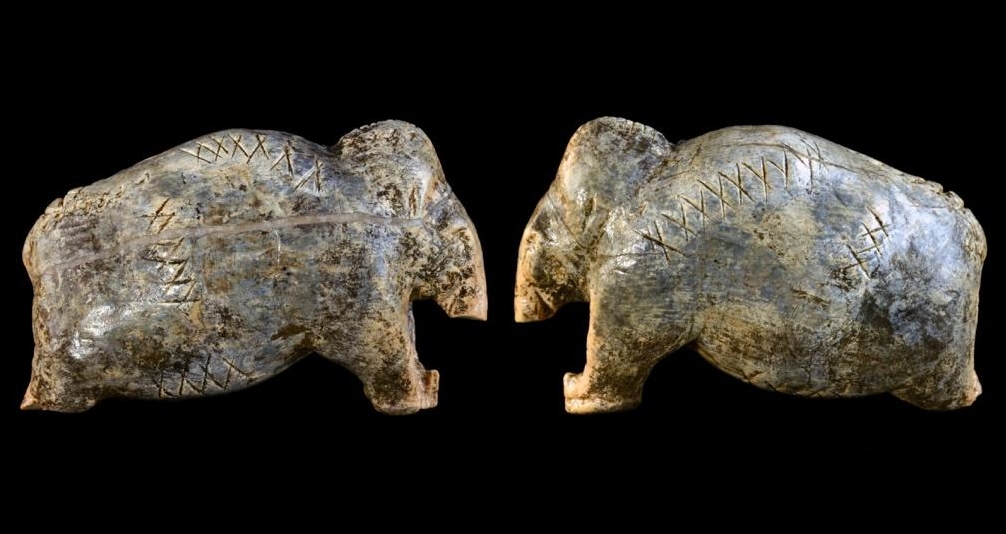
Bentz & Dutkiewicz, 2026, p. 2). Across this material, nearly 3,000 intentionally engraved geometric marks can be identified: dots, notches, lines, crosses, and recurrent combinations of such forms. The mammoth figurine from Vogelherd, the Löwenmensch from Hohlenstein-Stadel, and the Adorant from Geißenklösterle are among the objects through which this mobile graphic practice is documented (
Figure 1). These marks are approached first as ordered visual sequences rather than as images or words to be translated.
The analytical procedure converts sign sequences into numerical data. Frequency, regularity, predictability, entropy, and information density make it possible to examine whether the engraved marks display internal organization (
Bentz & Dutkiewicz, 2026, p. 2). Entropy measures the average amount of information carried by a sign in relation to its probability and context. The method does not recover the meanings of the marks. It describes prehistoric graphic sequences as patterned arrangements without reducing them to random ornament or converting them into an already deciphered notation.
The comparison with early proto-cuneiform works only at the level of information structure. Aurignacian portable objects and Mesopotamian tablets are separated by tens of thousands of years and belong to different material, social, and institutional worlds. Comparable information density does not imply historical descent from Swabian Jura marks to Mesopotamian writing (
Bentz & Dutkiewicz, 2026). It shows that patterned visual encoding can be measured outside the administrative setting of early states. Proto-cuneiform remains historically tied to accounting, redistribution, and institutional control in southern Mesopotamia (
Schmandt-Besserat, 1992).
The phenological hypothesis proceeds by assigning seasonal values to selected marks. Dots, lines, and Y-shaped signs associated with animal figures in Upper Palaeolithic parietal art are read as marks recording information about prey species (
Bacon et al., 2023, p. 7). Dots and lines are interpreted as lunar month markers counted from the beginning of the “good season,” while the Y-shaped sign is assigned the value of birth. The proposed system connects animal figures with mating, birthing, aggregation, and migratory cycles.
This hypothesis draws on repeated proximity between animal images and non-figurative marks. Upper Palaeolithic parietal art frequently represents herbivorous prey animals, and many animal figures are accompanied by dots, lines, or other abstract signs. A numerical sequence associated with a species could, in principle, correspond to lunar months within a seasonal cycle (
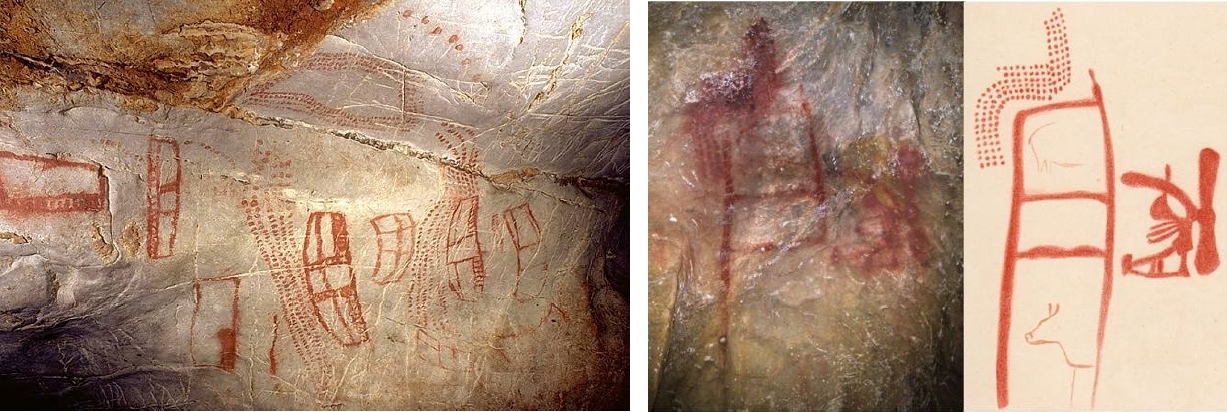
Bacon et al., 2023, p. 6). If such a reading were sustained, the signs would constitute a notational system older than Mesopotamian writing. The proposal places the selected marks between simpler notation and full writing. Examples from Lascaux, La Pasiega, Chauvet, Mayenne-Sciences, Pindal, and other sites are fitted into this seasonal framework (
Figure 2). The argument moves from visual association to code by assuming that similar marks retain stable values across different images, sites, and chronological contexts.
The lunar-calendar interpretation turns repeated marks near animal figures into a stable semantic code, but Dehaene’s criticism directly targets the evidentiary construction of that code. His wording is unambiguous: “The article was quickly demolished by several teams of established researchers. Filled with errors, it relies on partly false data, amateurishly collected from popular books and, above all, overinterpreted.” (
Dehaene, 2026, p. 50, translated by the author). He then adds that many decisions in the article are arbitrary, including the choice of spring as the starting point, the neglect of spring or autumn migrations, the uncertain direction from which the Y-shaped sign should be counted, and the use of inappropriate statistics. These decisions, he concludes, “remove all credibility from the vague correlation observed”: “the famous lunar calendar has no scientific basis” (
Dehaene, 2026, p. 50, translated by the author). The issue is therefore not the presence of repetition or numerical order, but the absence of a stable demonstration that the same graphic values operate across the selected figures, sites, and chronological contexts.
A stronger account of such signs requires a wider archaeological basis: the full graphic repertoire, the chronology of marks and figures, their spatial relations, and the reliability of the visual record. Palaeolithic art and symbolic behaviour cannot be interpreted apart from field observation, graphic context, and the variability of symbolic practices (
Paillet, 2016). A small group of selected signs cannot sustain the conclusion that a stable notational system has been identified unless the broader corpus, the conditions of association, and the material integrity of the evidence are addressed. Ferrara likewise warns against treating signs as immediately identifiable representations: “It all stems from the fact that signs are not iconic; they are not identifiable; they do not represent anything we can recognise. (…) We are victims who willingly fall into the trap of images, but above all of letters” (
Ferrara, 2023, p. 91, translated by the author).
The anthropological difficulty concerns the projection of modern utility onto prehistoric images and signs. Upper Palaeolithic graphic practices belonged to symbolic worlds that cannot be reconstructed through present-day expectations of storage, record-keeping, and practical information management (
Le Quellec, 2022, pp. 514–588). A sign associated with an animal may participate in temporal, ritual, classificatory, mythic, or territorial relations without functioning as a practical calendar. The possibility of notation remains open, but formal recurrence and semantic assignment remain different levels of analysis. As Le Quellec notes, “Setting aside academic disputes, all interpreters agree that Palaeolithic art was accompanied by rituals and words, without which it remains incomprehensible to us today” (
Le Quellec, 2022, p. 9, translated by the author).
The French debate on prehistoric signs had already raised this problem long before the recent phenological hypothesis. In 1897, certain abstract signs were compared with Phoenician characters, placing graphic resemblance at the center of the question of origins (
Piette, 1897). The analogy was fragile because resemblance cannot establish genealogy, meaning, or continuity. It nevertheless shows that the relation between prehistoric abstract signs and later writing has belonged to the history of research for more than a century. A stricter formal approach later shifted the question from resemblance to organization. Abstract signs from Franco-Iberian cave art were grouped into formal classes and examined through their relations within graphic configurations (
Sauvet et al., 1977). Non-figurative marks were no longer treated as simplified animal images or as already translated words. They became units whose recurrence, combination, and placement could be analyzed before any semantic recovery.
This formal approach identifies classes or “keys” of signs: circles, ovals, triangles, quadrilaterals, pentagons, claviforms, arrows, angular forms, and composite shapes (
Sauvet et al., 1977). A key is not a letter or a word. It is a formal unit that can recur, combine, contrast, or appear in relation to other units. Its value depends on its position within a graphic configuration. Such a procedure allows non-figurative marks to be analyzed without reducing them to decoration and without translating them into fixed verbal content.
Syntax names the relations among signs. In prehistoric semiology, syntax concerns order, category, dependence, and function within a grouping (
Sauvet et al., 1977). It can be observed in juxtaposition, sequence, superimposition, interlocking, spatial dependence, and contrast. A row of dots, a claviform sign, a quadrangular figure, or a sign beside an animal image can be studied through its place in a configuration. This is not phonetic syntax. It is a graphic syntax of relations among visible forms.
In Magdalenian contexts, recurrence and codification can be approached through sign families, panel organization, and the relation between abstract marks and animal figures. Sites such as Niaux, Castillo, and La Pasiega show that signs can be grouped, compared, and situated within larger visual arrangements (
Vialou, 1986). Their formal recurrence suggests patterned use, while their semantic value remains uncertain. The analysis remains at the level of classification, association, and spatial relation rather than translation.
A broader catalogue of Ice Age geometric signs extends this question across regions and periods. Recurrent forms such as dots, lines, open angles, circles, triangles, quadrangles, and other geometric signs can be examined through frequency, distribution, orientation, location, variability, and complexity (
von Petzinger, 2016). The resulting repertoire does not yield a universal code. It shows that certain graphic forms recur across sites while also varying locally and chronologically. Patterned use does not equal decipherment.
The analysis of prehistoric signs therefore moves from resemblance to recurrence, classification, distribution, positional relation, and formal combination. Resemblance-based comparison first opened the question of a relation between prehistoric signs and later writing (
Piette, 1897). Formal semiology then examined classes and relations among abstract signs without treating them as script (
Sauvet et al., 1977). Later work on Magdalenian signs and Ice Age geometric repertoires extended the same problem through codification, distribution, and local variation (
Vialou, 1986;
von Petzinger, 2016).
These lines of research remain distinct. Information density can be measured in engraved Aurignacian sequences without assigning them fixed meanings (
Bentz & Dutkiewicz, 2026). Selected dots, lines, and Y-shaped signs can be interpreted as a phenological code only if the assumptions about numerical value, seasonal beginning, and the stable meaning of the Y-shaped sign are sustained (
Bacon et al., 2023). French prehistoric semiology describes classes, recurrence, and relations among abstract signs without treating them as a deciphered script (
Sauvet et al., 1977;
Vialou, 1986).
The prehistory of writing appears, at this level, as a field of visual codification before script. Palaeolithic signs could be counted, classified, repeated, associated with animal figures, engraved on portable objects, and placed within structured spatial configurations. Their meanings remain uncertain. Their patterned existence cannot be reduced to ornament. The question is how matter began to retain organized differences capable of supporting memory, relation, and transmission before signs became writing in the strict historical sense.
4. Homo symbolicus and the Sacred Emergence of Prehistoric Writing
The graphic signs of prehistoric humanity first gained force in spaces where the visible world opened onto invisible relations. Cave walls, carved pillars, dolmens, menhirs, and ritual surfaces received images and signs through which human groups organized relations with animals, ancestors, death, territory, celestial order, and powers that could not be grasped directly. From this anthroposemiotic perspective, the origin of writing belongs to an older field of sacred mediation before it becomes stabilized in the administrative tablet (
Gendry, 2026).
Ferrara’s description of painted caves gives this older field its spatial ground. These caves were not ordinary visual surfaces or residential interiors. “The painted caves discussed in these pages were not habitable; they had nothing residential about them; they were not even frequented assiduously. In no case, from Indonesia to Spain, via France or Argentina, were these places where people spent much time. They were special, reserved, precious spaces” (
Ferrara, 2023, pp. 37–38, translated by the author). Darkness, distance, difficulty of access, and relative isolation changed the status of the images and marks placed on their walls. A sign encountered in such a space was approached through bodily entry, visual adjustment, and ritualized attention (Pétrognani, 2013, pp. 87–190).
At Lascaux, animal figures and geometric signs form a dense symbolic field (
Bataille, 2021;
Delluc, 1979;
Glory, 2008;
Leroi-Gourhan, 1965b). Pétrognani notes that Lascaux contains more than 400 symbols, including “punctures, straight lines, disjointed symbols, branch-like symbols, interlocking symbols, ‘filled symbols’, quadrangular symbols and claviform symbols” (
Pétrognani, 2013, p. 183, translated by the author; cf.
Leroi-Gourhan & Allain, 1979, p. 362). A rectangle, a series of points, a cluster of marks, or a quadrangular form draws the animal into a wider order of relations. The wall becomes a surface on which the animal is situated within a symbolic field that exceeds its empirical body (
Leroi-Gourhan, 1965b).
Prehistoric signs exceed representation understood as visual copying. The animal evokes a force beyond itself; the handprint links bodily presence to ritual mediation; the geometric mark introduces a symbolic value that cannot be exhausted by resemblance. A fragment, contour, trace, or figure can give access to a larger invisible order through metonymic force. Prehistoric graphic practice creates a material relation between the seen and the unseen (
Evin, 2017;
Ferrara, 2023;
Le Quellec, 2022).
The cave environment intensifies this relation. Darkness, depth, narrow passages, irregular surfaces, torchlight, and restricted access change the status of the image and the mark. Signs placed in such environments are encountered through approach, passage, bodily movement, and visual adjustment. Font-de-Gaume, Niaux, and Cosquer provide distinct archaeological contexts for such cave environments (
Cleyet-Merle, 2014;
Clottes, 2010;
Clottes & Courtin, 1994). The cave wall becomes a threshold surface where stone receives signs and gives them durability beyond the moment of ritual action (
Le Quellec, 2022;
Leroi-Gourhan, 1965b).
The myth of primordial emergence links this subterranean topography to narratives of origin. In Le Quellec’s analysis, Palaeolithic cave art often belongs to stories in which beings emerge from the depths of the earth, from fissures, holes, or passages that connect the human world to another order (
Le Quellec, 2022, pp. 617–619, 709–712). D’Huy also uses comparative and phylogenetic methods to reconstruct the long-term transmission and transformation of cosmogonic and mortuary mythic motifs (
D’Huy, 2020,
2023).
Ferrara’s discussion of vertical and monumental symbols provides the passage from parietal surfaces to built or carved forms. “You may call them superhuman creations, an aspiration toward immateriality or metaphysics, even, if you like, an expression of the divine. In any case, these symbols are the physical projections of something invisible, something we are not given to see” (
Ferrara, 2023, p. 186, translated by the author). This formulation gives the sacred sign a precise material status. The sign does not merely allude to an invisible order; it projects that order into matter and makes it available to interpretation.
Göbekli Tepe moves this sacred graphic logic from the cave environment to monumental architecture. Gendry connects a small green stone from Göbekli Tepe with Atlantic megalithic signs in a hypothesis about a shared mythological culture of engraving (
Gendry, 2024). Dated to the Pre-Pottery Neolithic, the site shows that large-scale collective organization could be oriented around carved pillars, animal figures, enclosures, and ritual construction before the full development of agricultural states (
Schmidt, 2015). Its pillars do not function as records of goods or obligations. They establish a public symbolic space in which animals, bodies, stone, and collective action are arranged into a durable order.
Ferrara treats Göbekli Tepe cautiously, without reducing it to a settled religious function. “For now, we can say that this site was also a place where people gathered to pray—or to meditate, or to commemorate the dead—but perhaps it was much more than that. In any case, if that was so, these would be the first temples ever discovered in the world. The zero point of a community beginning to settle. And perhaps the zero point of a visible language becoming symbol and code, perhaps an already formatted proto-writing” (
Ferrara, 2023, p. 204, translated by the author). As we can see from the repetition of “perhaps,” Ferrara does not turn Göbekli Tepe into writing. Rather, it places gathering, commemoration, visible signs, and symbolic coding within the same architectural field. Ferrara emphasizes the active force of such forms: “Images do not ‘exist’; they ‘font’. They are performative; they create movement. And we respond to their stimulus in a way that is certainly personal and unique, but in a way that belongs to everyone, for it is linked to sensory and motor simulation, not only of the brain, but of the whole body” (
Ferrara, 2023, p. 53, translated by the author).
The carved sign at Göbekli Tepe participates in the cohesion of a group gathered around monumental space. Animals, pillars, enclosures, and reliefs create an architecture of symbolic validation. The visible form authorizes a place, gathers memory, and gives public presence to relations that exceed ordinary social life (
Schmidt, 2015;
Ferrara, 2023). The sign acts in stone before it becomes a bureaucratic mark on a tablet.
This passage from cave walls to carved pillars changes the scale of inscription. The sign becomes architectural, public, and collective. It is no longer confined to a painted or engraved surface within a cave environment; it enters the organization of built space. The graphic act joins construction, gathering, and ritual coordination. Matter is made to hold symbolic relations through the shaping of a place.
The Atlantic megalithic monuments provide a further stage in this sacred history of graphic coding. Around the fifth millennium BCE, engraved signs on dolmens and menhirs in the Atlantic Arc, including the Carnac region, display recurrent motifs such as the square, the axe, and the boat (
Closmadeuc, 1873;
Gendry, 2025a;
Shee Twohig, 1981). Their arrangement has been interpreted as a structured symbolic language concerned with death, passage, rebirth, and cosmic orientation (
Cassen & Grimaud, 2020). The sign gives material form to a mythological culture centred on the path of the dead and the passage toward another order (
Gendry, 2025b;
Le Quellec, 1996).
The megalithic sign differs from the Palaeolithic cave sign in material, scale, and spatial setting. The cave places the sign within depth; the menhir and dolmen place it within landscape and monument. In both cases, the sign organizes a passage between worlds. The engraved boat evokes movement across a threshold; the axe and related forms mark force, authority, or ritual passage; the square gives bounded form to a symbolic space (
Cassen & Grimaud, 2020). Graphic coding organizes death and rebirth through visible marks (
Gendry, 2025b;
Le Quellec, 1996).
The Saint-Samson stele condenses this symbolic grammar into a spatial sequence. Its engraved surfaces have been read as an arrangement in which terrestrial anchoring, liminal transition, initiatory journey, and rebirth are distributed across the faces of the stone (
Cassen & Grimaud, 2020). The stele operates as a field of signs rather than as an inscription in the later linguistic sense. Each face contributes to a visual narrative in which the dead pass through a sequence of transformations toward cosmic renewal (
Maeder, 2021;
Maumené, 2024).
Carnac and the Atlantic megaliths extend sacred graphic coding beyond the Palaeolithic cave environment. The sign becomes monumental, exterior, and landscape-bound. It organizes the relation between stone, body, territory, death, and celestial order. The engraved surface becomes a ritual apparatus of memory. It holds a mythic structure in durable material form and places the community within a cosmos ordered by signs (
Cassen & Grimaud, 2020).
Cauvin’s account of the symbolic revolution places symbolic reorganization before the full transformation of subsistence, settlement, and economic administration (
Cauvin, 1994). This argument helps prevent the origin of signs from being reduced to later institutional needs. The first graphic codes can be understood as technologies for approaching the invisible: they convert a wild and unstable world into a cosmos ordered by signs.
The figure that emerges from this history is
Homo symbolicus. Before human beings appear as
Homo economicus, counting grain, registering labour, redistributing goods, and administering property, they appear as symbolic animals who organize the world through visible marks. The need to express the sacred through order and code precedes the need to manage the profane. The anthropological condition of writing lies in the human ability to stabilize invisible relations through material signs (
Cauvin, 1994;
Ferrara, 2023).
The administrative tablet belongs to a later transformation of this graphic power. It attaches signs to goods, names, accounts, and obligations. The cave wall, the carved pillar, and the menhir operate in another register: they order animals, ancestors, passage, death, territory, and cosmic orientation. Each depends on the same material act. Matter is made to retain a symbolic relation beyond the moment of gesture, speech, or ritual performance.
The sacred emergence of prehistoric writing lies in this continuity of graphic exteriorization. Lascaux, Göbekli Tepe, and Carnac do not form a single script, and their signs do not lead directly to Mesopotamian cuneiform. They reveal an older capacity of signs to organize worlds. Stone becomes memory; the wall becomes a mediator; the pillar becomes a public axis of collective validation; the megalith becomes a map of passage. Writing, in its later institutional sense, crystallizes one branch of this older symbolic work.
The anthroposemiotic origin of writing is inseparable from the sacred history of signs. Human groups marked surfaces in order to establish relations, consecrate spaces, stabilize myths, and orient themselves among visible and invisible powers. The sign was already performative before it was bureaucratic. It made a world by binding bodies, animals, stones, ancestors, and cosmic forces into durable configurations. The path from prehistoric sign to writing begins in this sacred work of graphic ordering.
5. The Emergence of Homo graphicus: Image, Gesture, and Exosomatic Memory
Upper Palaeolithic groups lived in oral cultures in which myth, memory, gesture, sound, and collective performance organized social life. Myths linked individuals to groups, gave structure to relations among humans and animals, and transmitted shared accounts of origin, death, territory, and invisible powers (
Leroi-Gourhan, 1964b). Painted and engraved caves belong to this oral and ritual environment. They do not replace speech with writing, but give visual form to narratives that were spoken, enacted, sung, remembered, and transmitted through bodies moving in space (
Clottes & Lewis-Williams, 1996;
Leroi-Gourhan, 1965b).
The cave can therefore be approached as an audiovisual system. Images were encountered within a space of voice, resonance, percussion, breath, and bodily movement. Flutes, percussive sounds, spoken narratives, and sung sequences may have accompanied the visual experience of painted and engraved surfaces (
Clottes & Lewis-Williams, 1996;
Leroi-Gourhan, 1965b;
Reznikoff, 2008). The image belonged to a performative field in which seeing, hearing, moving, and remembering were joined.
This audiovisual field presupposes a high degree of abstraction. The makers and participants of painted and engraved caves must have distinguished between the animal itself and its image, between the visible mark and what it signified, between referent, signifier, and signified. Their language may have been sophisticated enough to sustain mythic narratives, ritual sequences, and symbolic relations, but it was not writing in the strict sense of a script. The cave did not contain a verbal text awaiting direct translation. Leroi-Gourhan’s comparison gives this methodological limit its sharpest form: “we can discern an order but not its meaning” like “a situation comparable to that of a Martian visitor wandering through an abandoned cathedral on this planet.” (
Leroi-Gourhan, 1965b, p. 149 in the 1967 English translation). The formal arrangement remains perceptible, while the ritual voice and living doctrine that once animated it have disappeared.
The loss of meaning does not make the images mute. It changes the level of analysis. The animal figure, the handprint, the line, the dot, and the abstract motif preserve traces of a symbolic system whose verbal key has disappeared. Leroi-Gourhan’s comparative model of Palaeolithic cave sites shows that images and signs were organized through recurrent relations rather than scattered by chance (
Leroi-Gourhan, 1965b). The task is therefore to analyze morphology, placement, recurrence, and association before translating signs into fixed meanings (
Sauvet, 1993;
Sauvet et al., 1977;
Vialou, 1986;
von Petzinger, 2016, pp. 219–222).
The emergence of this visual field belongs to a broader perceptual and cognitive history. Miki Ben-Dor and Ran Barkai have proposed that the decline of large prey animals functioned as a major ecological selecting agent in Pleistocene human evolution. As large mammals became rarer, humans increasingly had to pursue smaller, faster, and more elusive animals, a shift that would have favoured planning, technological adaptation, tracking, social coordination, and refined perception (
Ben-Dor & Barkai, 2021). This hypothesis does not explain cave art by itself, but it situates image-making within an ecology in which attention, memory, animal knowledge, and the reading of traces became increasingly consequential.
Cave images testify to this refinement of perception. The animal is not copied as a passive visual object. It is grasped, selected, isolated, and transformed into visible form. The line extracts a contour from the moving world; the drawing separates a figure from its environment; the painted animal condenses a living presence into an image. Spatial transposition is at stake here. The experienced world is translated from three dimensions into two, from movement into mark, from perception into graphic form. Such transposition requires the mind to detach, reorganize, and project what it has seen (
Ego, 2016).
The human being is present in cave art as the hand that marks and the eye that selects. The image testifies less to the motif alone than to the act by which the motif is detached from the surrounding animal world and placed on a surface. In representing animals, humans also produce a distance from them. This distance allows the human group to contemplate the world, to ask about its own relation to it, and to organize that relation through images (
Ferrara, 2023;
Leroi-Gourhan, 1964a).
Chauvet reveals the extent to which this operation already involved trained perception and controlled gesture. Its paintings confront us with “their very high level of completion: accuracy of line, delicacy of observation, effects of shaded modeling, depth” (
Guy, 2017, p. 13, translated by the author). Guy links this level of accomplishment to training, regular exercises over years, a considerable investment of time and energy, and pictorial knowledge not directed toward immediate survival. Chauvet’s realism therefore presupposes discipline, transmission, and a community capable of recognizing pictorial mastery.
The realism of Chauvet cannot be reduced to a desire to imitate the visible world. Through line, shading, depth, and movement, the animal is rendered as a presence rather than as a mere outline. Such technical control gave figurative images a force that could sustain ritual, social, or symbolic investment (
Guy, 2017, pp. 207–222). Yet naturalism did not simply produce a more convincing representation of animals. It also developed within changing conditions of stylistic transmission. As Guy observes: “Whereas, 22,000 years ago, a single artistic tradition was shared throughout the south-west of Western Europe–not to mention the spread of the Venus figurines–we see artistic forms and themes developing during the Magdalenian period that now appear to be confined to a single region, or even a single valley. How, then, can we explain the coincidence between this retreat–at least in terms of style–and the growing development of artistic naturalism? Here again, it is tempting to establish a link between the improvement in climatic conditions–and hence the increase in resources–and the significant reduction in the geographical spread of figurative symbols, and thus of the style” (
Guy, 2017, p. 213, translated by the author).
Guy asks what social conditions made such technical accomplishment possible: “What is the social significance of the style of the paintings at Chauvet, Altamira and Lascaux? Why was so much effort devoted to representation? What sort of society could possibly have encouraged the development of a pictorial art so advanced that we can, without exaggeration, elevate its finest practitioners to the rank of artists?” (
Guy, 2017, p. 12, translated by the author). Chauvet, Lascaux, Altamira, Ekain, and Niaux presuppose learned conventions of representation, sustained control of the hand, and viewers able to recognize pictorial skill. Such works cannot be explained as isolated graphic acts. They point to training, transmission, and forms of collective evaluation, even where the narratives and ritual meanings once associated with them can no longer be recovered (
Guy, 2017).
The movement from perceived animal to drawn figure is a cognitive transformation. Drawing requires a feedback loop between visual perception and manual control. Ferrara writes that one must “control the segments of the line, anticipate error, harmonize the fingers of the hand with the eye” (
Ferrara, 2023, p. 42, translated by the author). The hand does not deposit a ready-made image onto the wall. It adjusts perception through movement, while the surface receives the result of a visual-motor negotiation in which the eye selects, the hand corrects, and the line becomes form.
The reduction of three-dimensional perception to a two-dimensional surface gives the image its abstract power. The perceived animal is first encountered as a three-dimensional body, then reconstituted as a flattened figure made of lines, points, silhouettes, and contours (
Ferrara, 2023). The drawn animal is therefore a reduction, a memory, and a projection. It carries the trace of an encounter with a living body, but it survives as a graphic form detached from that encounter.
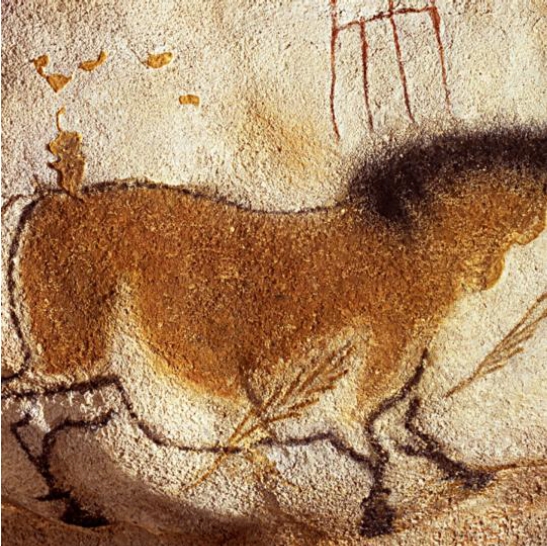
The graphic act also depends on the surface that receives it. The rock face is not a passive wall onto which an already formed image is simply imposed. Its fissures, ridges, hollows, bumps, and protuberances guide the gesture, suggest contours, and invite the image (
Figure 3). Ferrara writes: “The fissures, projections, bumps, holes, and protuberances are so many invitations; they suggest the drawing” (
Ferrara, 2023, p. 39, translated by the author). The wall participates in the formation of the figure. It becomes a membrane between the material world and the imagined world.
This relation between hand and wall is especially clear at Altamira. The painter does not ignore the rock’s relief; he uses it to give anatomical volume to the bison. Natural protrusions become the animal’s withers, hollows can become the site of an eye, and the uneven ceiling turns into a field where anatomy and interior geology are fused. The figure arises from a dialogue between mineral surface and manual gesture. The image is not placed on the wall; it is drawn out of the wall.
This co-emergence of gesture and art changes the status of the cave image. Cave painting is not only a figurative representation; it is an action upon memory, society, and the sacred. Every graphic gesture is performative because it produces effects in a psychological, social, and symbolic order. The hand that follows the rock’s relief establishes a relation among body, surface, animal, memory, and invisible power.
The movement from experienced world to image therefore depends on the hand. The hand is not a secondary instrument that executes an already formed idea. It participates in the formation of thought by externalizing it into matter. The pressure of the fingers, the movement of the wrist, the control of pigment, the incision of line, and the shaping of contour bind motor action to symbolic form. The hand becomes the organ through which perception leaves the body and takes material form (
Ferrara, 2023;
Leroi-Gourhan, 1964a).
The relation between hand and cortex defines the emergence of
Homo graphicus. Leroi-Gourhan’s analysis of gesture and technics links the development of the human brain to the liberation and specialization of the hand (
Leroi-Gourhan, 1964a). The precision of painting or engraving requires planning, anticipation, kinesthetic memory, inhibition, and controlled motor execution. The hand becomes an extension of the cortex: not a tool outside thought, but the bodily means by which thought enters material form.
The earliest graphic marks belong to the same broad anthropological field as tool-making. A tool transforms matter in order to act on the world; a mark transforms matter in order to retain a relation to the world. Both require controlled gesture, anticipation, and technical memory. Leroi-Gourhan describes the formation of a system capable of “permanently preserving the fruits of individual and collective thought” (
Leroi-Gourhan, 1964a, p. 187 in the 1993 English translation). The engraved line, the painted contour, and the handprint belong to this history: matter begins to preserve what gesture and voice cannot retain by themselves.
The handprint offers the clearest form of this externalization. As a trace, it indicates that a body was there. As a sign, it detaches that presence from the living body and fixes it on the wall. As a symbol, it becomes available for mediation, ritual, identity, or communication. The same hand that once read traces in the world now produces traces for others to read. Human beings no longer only interpret the marks left by animals, weather, or movement. They begin to inscribe the world by placing intentional traces into it (
Ferrara, 2023;
Leroi-Gourhan, 1964a).
This externalization produces what may be called exosomatic memory. A handprint, a finger trace, a line incised in bone, or a pigment mark on stone gives the gesture a life beyond the moment of its production. Stiegler gives this process its technical formulation: “human memory is originarily exteriorized, and that means that it is technical from the start” (
Stiegler, 2010, p. 67). The sign survives the body that produced it. It can be encountered again, recognized, repeated, and transmitted. Memory moves outside the organism and becomes attached to a durable surface. The cave wall becomes a body of memory because it retains symbolic differences beyond the living performance that produced them.
The Latin
digitus reminds us that this history remains tied to the finger. Counting, pointing, touching, marking, pressing, and tracing all begin with the body. The digital does not first belong to machines; it begins with the finger as a unit of action and discrimination. Ferrara’s discussion of finger traces and numbers links the fingers to sequential, intentional, counted gestures and to a sophisticated cognitive play with quantity (
Ferrara, 2023). From the hand pressed on a cave wall to the finger moving across later writing surfaces, graphic mediation remains linked to manual gesture. The mark begins as bodily contact and becomes a durable sign.
6. Gramme, Geometry, and the Recursive Structure of Prehistoric Signs
The dots, lines, grids, and other non-figurative marks considered here cannot be interpreted by identifying a depicted object; they must first be described through the concept of the
gramme. In
De la grammatologie, Derrida writes that “the history of writing is erected on the base of the history of the
gramme” and adds that “one cannot think them without the most general concept of the
gramme” (
Derrida, 1967, p. 84 in the 1976 English translation). The
gramme does not designate a historical script. It designates the more general condition through which trace, spacing, difference, and material retention become thinkable before writing is restricted to phonetic or linguistic inscription.
Prehistoric geometric signs can be approached within this broader history without being turned into letters. A line, dot, grid, tectiform sign, claviform mark, or quadrangular figure does not transcribe speech. Yet such forms already transform surfaces into fields of differentiated marks (
Leroi-Gourhan, 1965a, p. 261;
von Petzinger, 2016). They allow matter to retain intervals, oppositions, repetitions, positions, and internal relations. Prehistoric geometry belongs to the prehistory of writing as a durable organization of graphic difference, not as an early alphabet.
The study of geometric signs has always faced two related difficulties: ambiguity and subjectivity. A single form can be described as tectiform in one context and ramiform in another. A grid-like sign may suggest a hut, a field, an enclosure, a trap, a net, or an abstract partition. The terminology used by prehistorians registers this difficulty. Terms such as tectiform, claviform, penniform, or scutiform name formal resemblance without turning resemblance into decipherment (
Chollot-Varagnac, 1980;
Leroi-Gourhan, 1965b;
Sauvet, 1993;
von Petzinger, 2016, pp. 219–222).
Resemblance easily produces interpretive excess. A tectiform sign may recall a roof, but the resemblance does not prove that it represents a house. A claviform sign may recall a club, but the resemblance does not prove that it denotes a weapon. A grid may recall a field, a trap, or an enclosure, but none of these analogies can be treated as semantic proof. Leroi-Gourhan’s classification of abstract signs through male and female symbolic oppositions shows both the ambition and the risk of interpretive typology (
Leroi-Gourhan, 1966). The formal stability of a sign does not guarantee the stability of its meaning.
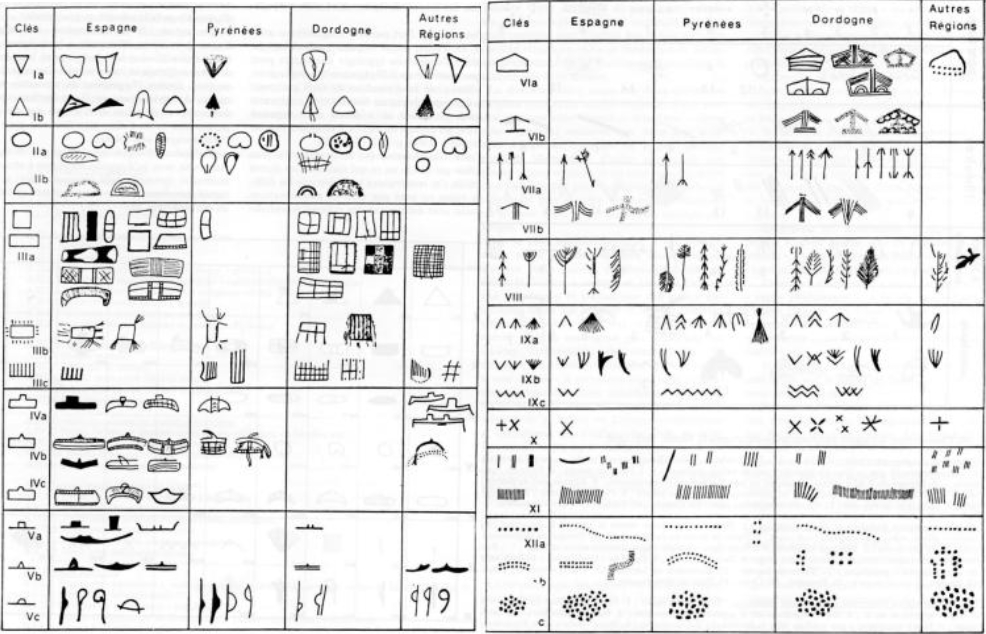
A more cautious analysis begins with operation. Geometric signs can be studied by asking how they are constructed, repeated, combined, partitioned, and embedded. von Petzinger’s catalogue of recurrent Upper Palaeolithic signs shows that dots, lines, open angles, circles, triangles, quadrangles, tectiforms, and other signs recur across sites, periods, and regions, even though no single cave contains the whole repertoire and local variation remains significant (
von Petzinger, 2016). The signs belong to a limited but variable graphic vocabulary (
Figure 4).
French prehistoric semiology had already opened this level of analysis. Sauvet, Sauvet, and Wlodarczyk classified abstract signs into formal “keys” and examined the relations among non-figurative graphic units (
Sauvet et al., 1977). Syntax, in this context, does not mean grammatical syntax in the linguistic sense. It refers to the ordering of visible units: proximity, association, recurrence, contrast, distribution, and position. Such work allows prehistoric signs to be treated neither as arbitrary ornament nor as deciphered writing, but as structured relations among graphic forms (
Sauvet, 1993;
Sauvet et al., 1977).
Geometric signs concentrate operations that are simpler than script but more abstract than image. A point can be repeated; repeated points can become a row; a row can be interrupted, grouped, or placed beside another sign. A line can enclose, divide, connect, or separate. A quadrangle can frame an interior, and a grid can turn the surface into a set of positions. These operations produce order without producing phonetic writing.
Repetition, concatenation, and embedding are central to this order. Dehaene formulates their recursive character in a sentence that directly bears on prehistoric geometric signs: “all these operations function recursively: not only can we repeat, concatenate or embed simple forms such as a point or a line” (
Dehaene, 2026, p. 55, translated by the author). The same operations can be composed with one another to generate increasingly complex figures. A repeated unit can itself be repeated; a concatenated sequence can be embedded; an embedded form can contain further repetitions.
This recursive capacity links prehistoric geometry to a broader account of human symbolic thought. Dehaene treats recursive language as a possible exclusive signature of the human species, since many lines of evidence suggest that other animals do not productively recombine signs in this way (
Dehaene, 2026). The point is not limited to spoken language. Geometric marks show that recursive composition also belongs to visual thought: simple elements can be combined, nested, extended, and recombined without becoming words.
Repetition is the first operation. A single dot or stroke may remain close to trace, gesture, or isolated sign. Repetition changes its status. A line of dots, a row of strokes, or a repeated angle produces expectation, rhythm, and order. The repeated unit becomes part of a series. It can be counted, compared, extended, interrupted, grouped, or placed beside another form. This operation is visible in Palaeolithic sequences of dots and lines on cave walls, portable objects, and engraved artifacts (
von Petzinger, 2016, pp. 14–15, 96–97).
Concatenation adds a second level of organization (
Dehaene, 2026, pp. 124–126). Units no longer merely recur; they are linked. A dot may be followed by a line, a line by an angle, an angle by a quadrangular form. The sequence becomes a chain of relations. Concatenation does not require phonetic writing, but it introduces ordered combination. It produces adjacency, succession, and dependency among graphic units. Non-figurative sequences matter for the prehistory of writing because they show that visual signs could be organized relationally before they became linguistic signs (
Sauvet et al., 1977).
Embedding introduces a third operation (
Dehaene, 2026, pp. 127–130). A form can contain another form; a grid can divide a surface into compartments; a quadrangle can frame internal marks; one structure can be nested within another. Embedding creates hierarchy and depth within the graphic field. As Dehaene writes, “Geometric forms are not perceived as simple images. Our brain analyzes them like the sentences of a computer language: it decomposes them into programs, themselves composed of subprograms, until they form a tree structure resembling that of a sentence” (
Dehaene, 2026, p. 127, translated by the author). The sign becomes more than a mark on a surface. It organizes internal relations and assigns value through position, enclosure, and difference.
The combination of repetition, concatenation, and embedding explains how geometric signs move beyond ornament. A grid, tectiform sign, or quadrangular figure is not meaningful because it resembles a known object. It is meaningful because it organizes distinctions. The sign produces relations among marked and unmarked spaces, internal divisions, and positional values. Its meaning may remain opaque, but its structure can still be analyzed.
The quadrangular sign occupies a central place in this development. Unlike the animal contour, the square or rectangle does not arise as a living form given in nature. It is constructed through straight lines, angles, enclosure, and partition (
Dehaene, 2026, p. 57). To draw a quadrangular sign on a curved or irregular cave surface is to project mental geometry onto the natural support. The hand no longer follows the body of the animal; it imposes an invented structure on matter. The sign moves from imitation toward conceptual organization.
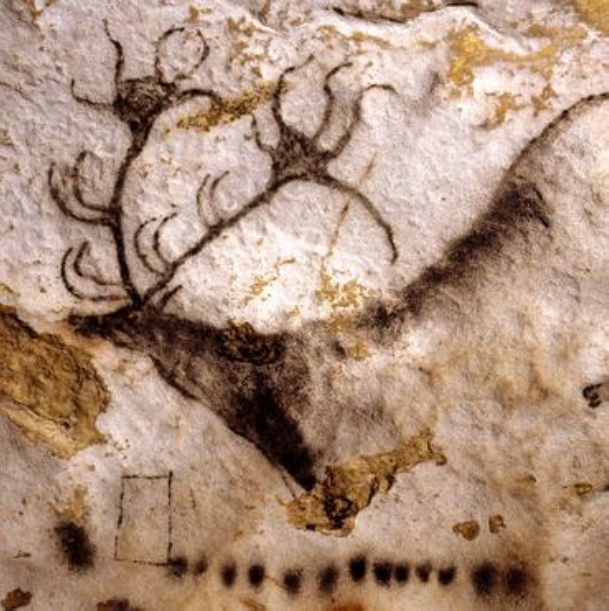
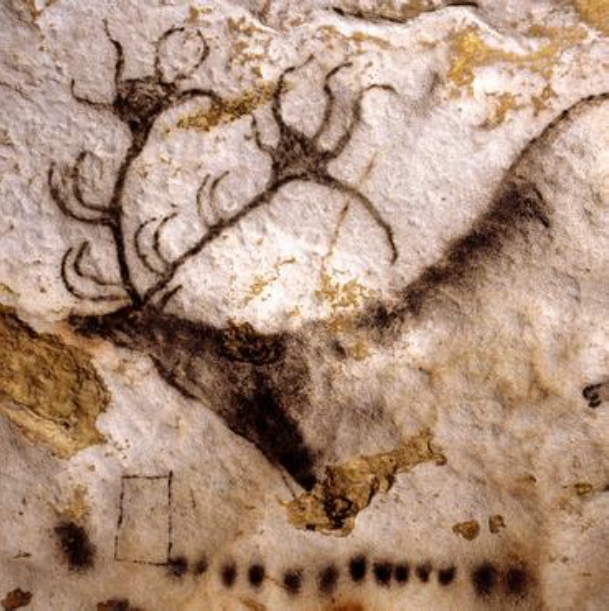
The rectangle at Lascaux makes this operation especially visible. Beneath the great stag, the quadrangular form does not imitate any obvious natural body (
Figure 5). It introduces straightness, enclosure, and angularity into a field otherwise dominated by animal figures and irregular stone. The figure shows that the cave surface could receive not only images of beings, but also abstract structures of relation. The quadrangle turns a portion of the wall into an organized field.
The chequered or compartmentalized quadrangular sign intensifies this movement. Its internal divisions produce a system of presence and absence. A compartment may be filled or empty, marked or unmarked, differentiated or left blank. Value emerges from the distinction between occupied and unoccupied positions. The sign no longer depends on representing a visible object. It organizes a field of possible values through partition, contrast, and positional difference (
Dehaene, 2026).
At this level, durable graphic difference has both a philosophical and a cognitive dimension. The
gramme names the spacing and retention through which matter can hold distinctions before script (
Derrida, 1967). Derrida writes that writing designates not only “the physical gestures of literal pictographic or ideographic inscription,” but also “all that gives rise to an inscription in general, whether it is literal or not and even if what it distributes in space is alien to the order of the voice” (
Derrida, 1967, p. 9 in the 1976 English translation). This extension reaches “the entire field covered by the cybernetic program” and precedes the distinction between the human and the nonhuman: “Even before being determined as human … or nonhuman, the gramme—or the grapheme—would thus name the element” (
Derrida, 1967, p. 10 in the 1976 English translation).
Repetition, concatenation, and embedding name the operations through which simple visual elements become structured forms (
Dehaene, 2026). A quadrangular sign is not a written sentence, but it already involves spacing, iteration, internal organization, and material retention. It makes matter hold a system of distinctions. The difference between a hand trace and a strict grid can now be specified. A handprint records presence: a body touched the surface. Its ritual or symbolic value may exceed that indexical function, but its form remains tied to bodily contact (
Ferrara, 2023;
Leroi-Gourhan, 1964a). A grid or quadrangular sign operates differently. It manages relations among positions. It partitions the surface, organizes absence as well as presence, and creates a stable structure that can be recognized and returned to. The mark moves from the trace of presence toward the ordering of memory.
This movement does not belong to
Homo sapiens alone in its earliest beginnings. Neanderthal finger traces at La Roche-Cotard show that intentional marking and the transformation of space through lines and dots preceded the full development of Upper Palaeolithic graphic systems (
Marquet et al., 2023). The symbolic use of marine shells and mineral pigments by Iberian Neandertals provides a separate case of durable material sign use before Upper Palaeolithic graphic systems (
Zilhão et al., 2010). Yet the systematic use of geometric organization among
Homo sapiens introduces a new level of abstraction. What began as a material intervention in space becomes a structured graphic technology. Geometry turns the surface into an organized field.
The square has special force because it is purely constructed. Curves, silhouettes, and animal profiles can arise from the living world. A right-angled grid imposes a structure that the living world does not offer in complete form. By projecting straight lines and right angles onto the irregularity of rock,
Homo sapiens stops imitating the living world and begins to impose a mental order upon natural chaos. The world is no longer only represented; it is reorganized according to an internal schema (
Dehaene, 2026, p. 145).
The relation between quadrangular signs and other recurrent signs reinforces this symbolic operation. Claviform or L-shaped signs, weapon-like forms, and other motifs may appear near or within such structures. Modern eyes may see weapons, tools, schematic objects, or architectural forms. A prehistoric semiotic approach must proceed more carefully. Such signs may have marked power, status, territorialization, ritual control, or the sorting of invisible beings. Their value lies less in resemblance than in their capacity to impose order on a field of forces (
Sauvet et al., 1977;
Vialou, 1986).
The quadrangular sign condenses several operations that make coding possible: segmentation, repetition, opposition, enclosure, and internal hierarchy. It also reveals why geometric signs are central to the prehistory of writing. Writing will later stabilize language, number, and administration through ordered signs. Geometric abstraction had already shown that visual marks could organize memory by arranging differences on a surface (
Dehaene, 2026;
von Petzinger, 2016).
The history of the gramme is not a straight line from cave mark to alphabet. It is the history of increasingly complex operations by which matter comes to retain difference. The trace gives presence durability; repetition gives the mark recurrence; concatenation gives recurrence order; embedding gives order internal depth; the grid gives depth a system of positions. Long before script, prehistoric signs had already explored these operations through graphic form (
Derrida, 1967;
Dehaene, 2026).
This stage in the prehistory of writing is geometric and relational. Its signs do not disclose their meanings, but they show how visual thought can become structured (
Anati, 2006;
Sauvet, 1993). The quadrangular sign, the grid, the tectiform motif, and the repeated sequence reveal a mind capable of constructing order from minimal graphic units. Prehistoric geometry thus belongs to the deep history of writing because it makes memory depend on organized differences preserved in matter.
7. Conclusion: Semiotic parallelism and coevolution of different sign systems
Writing acquired its fully institutional form when tablets could register goods, labour, names, quantities, and obligations within the administrative life of early cities. Proto-cuneiform made information durable, portable, and available for repeated institutional use (
Gelb, 1963;
Goody, 1986;
Schmandt-Besserat, 1992). Its historical emergence nevertheless presupposed much older practices through which human groups had learned to leave intentional marks, repeat forms, distinguish positions, organize surfaces, and preserve relations outside immediate speech and bodily presence.
Cave walls, engraved bones, marked stones, shells, ivory objects, handprints, animal figures, and geometric signs belong to this longer history. Their meanings cannot be recovered as though they were entries in a lexicon or sentences in an unknown script (
Leroi-Gourhan, 1966). Yet their material arrangement shows that they were not indifferent marks. Animal contours, rows of dots, repeated strokes, tectiforms, claviforms, grids, and quadrangular forms organized relations among bodies, animals, surfaces, movement, memory, and ritual knowledge. The marked surface retained relations that could be revisited, recognized, and reactivated after the gesture that produced them had ended (
Ferrara, 2023;
Leroi-Gourhan, 1964a,
1965b;
von Petzinger, 2016).
The history considered here therefore comprises three interdependent semiotic domains: spoken language, graphic language, and writing. Gesture moves among all three. Ferrara writes: “We are hands. We see hands moving when someone speaks and we imitate them, repeating the gesture to respond with empathy (again, the mirror neurons). We create symbols with our hands. (…) We are also gestures” (
Ferrara, 2023, p. 242, translated by the author). Speech unfolds through voice, rhythm, posture, and collective performance; graphic forms convert gesture into visible traces; writing stabilizes selected graphic relations within more regulated systems of record and transmission. Upper Palaeolithic cave art belongs to the interval in which oral narration, ritual action, sound, image, and marking remained closely interwoven. The painted bison, the hand stencil, the engraved line, and the abstract sign could participate in collective practices of memory and invocation without functioning as phonetic notation.
This relation also places paleolinguistics and the semiotics of cave art in parallel. Proto-languages are unavailable as direct recordings; they are reconstructed through regular correspondences among later languages. Prehistoric images and signs likewise lack explanatory captions or surviving accounts from their makers. Their study depends on converging evidence: archaeological context, formal recurrence, spatial distribution, material technique, comparison, and anthropological analogy. Linguistic reconstruction cannot restore an original voice with certainty, and cave-art analysis cannot restore an original myth with certainty. Both fields work from surviving traces whose former worlds must be approached through constrained inference rather than direct recovery.
The patterned character of prehistoric signs provides the basis for such inquiry without authorizing premature decipherment. Quantitative analyses of Aurignacian engraved objects have shown that some sign sequences display non-random distributions and measurable information density (
Bentz & Dutkiewicz, 2026). French prehistoric semiology has approached non-figurative signs through formal classes, recurrence, association, and spatial syntax (
Sauvet et al., 1977). The disputed phenological-calendar proposal has exposed the opposite danger: formal regularity can be transformed too quickly into a determinate semantic code (
Bacon et al., 2023;
Dehaene, 2026). A prehistoric anthroposemiotics must retain both insights. It must take patterned graphic organization seriously while refusing to treat every repeated mark as a recovered message.
The sacred dimension of prehistoric signs belongs to the same problem. In caves, sanctuaries, carved pillars, and megalithic landscapes, graphic forms helped establish relations among the visible world, animals, ancestors, death, territory, and powers that exceeded ordinary experience. The image or mark did not stand outside those relations as a neutral representation. It participated in their enactment. A painted animal could carry ritual force; a handprint could preserve a bodily presence; a geometric form could organize a field of positions, divisions, and symbolic values. Such practices made matter available as a medium through which a group could bind memory, gesture, image, and cosmological order.
The origin of writing therefore belongs to a long anthropological process in which signs gradually acquired durable material supports, increasingly stable forms, and wider capacities for transmission. The administrative tablet represents one historical transformation within that process: graphic practices became standardized for accounting, classification, legal obligation, and institutional memory. Its emergence did not erase the older ritual and symbolic histories of inscription. It redirected them toward a new social apparatus in which marks could circulate beyond particular places, performances, and communities.
An anthroposemiotics of prehistoric writing should examine this longer history across the connected domains of archaeology, cognitive science, paleolinguistics, semiotics, and the study of ritual practice. Its central question concerns neither the first word ever spoken nor the first image ever drawn in isolation. It concerns the ways in which early Homo sapiens organized vocal, gestural, and graphic signs into systems capable of producing shared worlds. Spoken language and cave art remain distinct forms of evidence, but both preserve traces of the same symbolic capacity: the capacity to select, combine, repeat, transform, and transmit signs in order to make experience communicable beyond the immediate moment.
Figure 1.Mammoth ivory figurine from Vogelherd
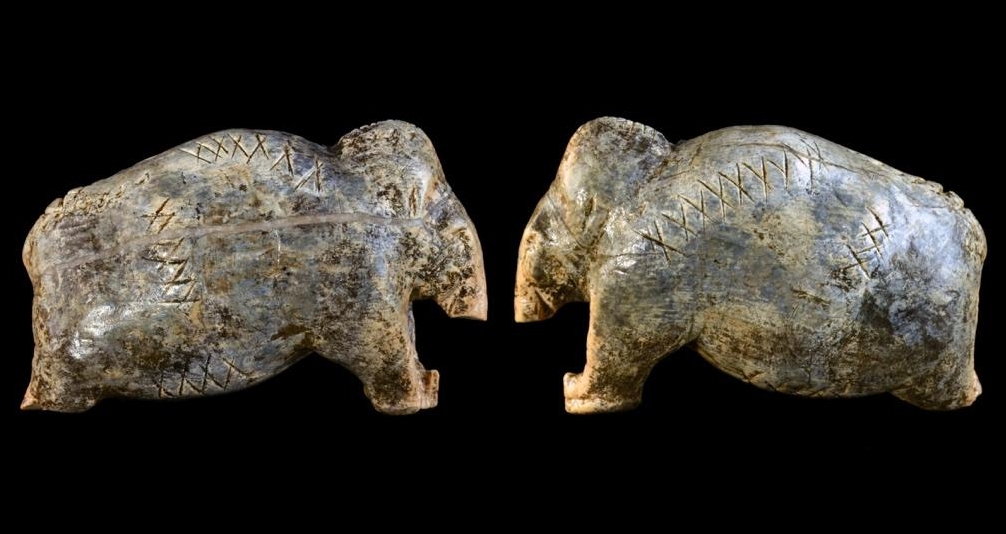
Figure 2.Abstract Signs from El Castillo and La Pasiega
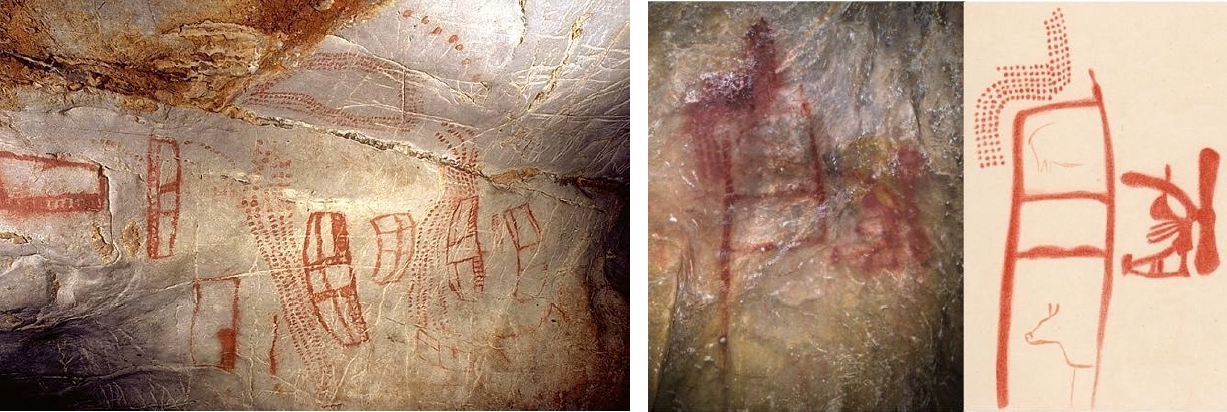
Figure 3.
Chevaux chinois from Lascaux, painted over an undulating rock bulge
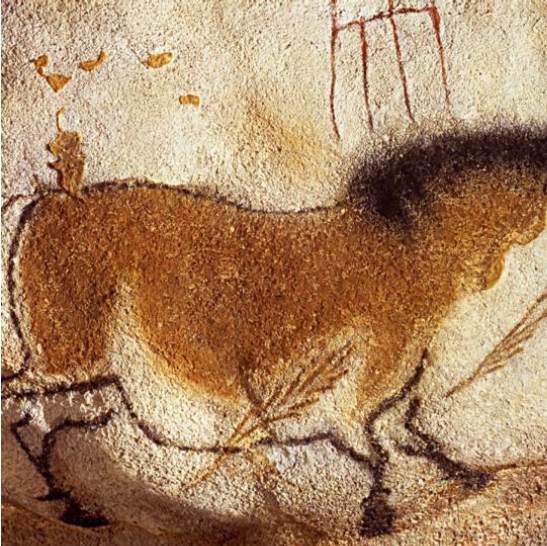
Figure 4.Typology of geometric signs (Sauvet et al., 1977)
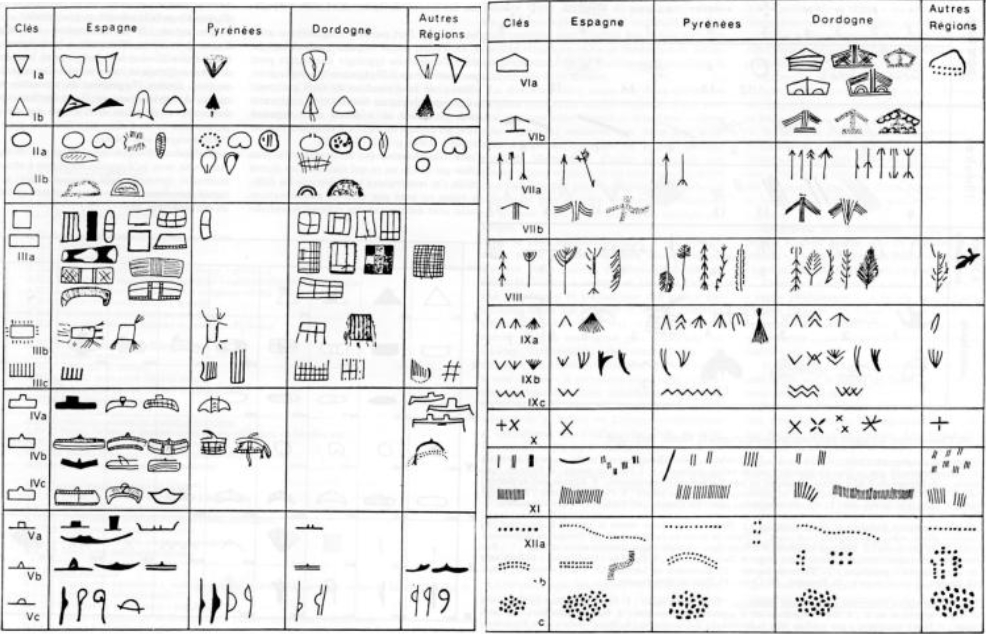
Figure 5. A quadrangular sign from Lascaux
REFERENCES
- Anati, E. (2006). Structure of art, structure of mind. Diogenes, 21495-115. https://doi.org/10.3917/dio.214.0095
- Aubert, M., Lebe, R., Oktaviana, A. A., Tang, M., Burhan, B., Hamrullah, Jusdi, A., Abdullah, B., Hakim, B., Zhao, J.-X.., Geria, I. M.., Sulistyarto, P. H.., Sardi, R., & Brumm, A. (2019). Palaeolithic cave art in Borneo. Nature, 564254-257. https://doi.org/10.1038/s41586-018-0679-9
- Bacon, B., Khatiri, A., Palmer, J., Freeth, T., Pettitt, P., & Kentridge, R. (2023). An upper Palaeolithic proto-writing system and phenological calendar. Cambridge Archaeological Journal, 33(3), 371-389. https://doi.org/10.1017/S0959774322000415
- Bataille, G. (2021). Lascaux ou la naissance de l’art. L’Atelier contemporain. (Original work published 1955).
- Ben-Dor, M., & Barkai, R. (2021). Prey size decline as a unifying ecological selecting agent in Pleistocene human evolution. Quaternary, 4(1), Article 7. https://doi.org/10.3390/quat4010007
- Bentz, C., & Dutkiewicz, E. (2026). Humans 40,000 y ago developed a system of conventional signs. Proceedings of the National Academy of Sciences of the United States of America, 123(9), Article e2520385123. https://doi.org/10.1073/pnas.2520385123
- Bottéro, J. (1987). Mésopotamie : L'écriture, la raison et les dieux. Gallimard.
- Breuil, H. (1952). Quatre cents siècles d’art pariétal : Les cavernes ornées de l’âge du renne. Centre d’études et de documentation préhistoriques.
- Cassen, S., & Grimaud, V. (2020). La clef de la mer : Une étude des représentations gravées sur la Pierre de Saint-Samson (Côtes-d’Armor). Lithogénies / Université de Nantes.
- Cauvin, J. (1994). Naissance des divinités, naissance de l’agriculture : La révolution des symboles au Néolithique. CNRS Éditions.
- Chollot-Varagnac, M. (1980). Les origines du graphisme symbolique : Essai d’analyse des écritures primitives en préhistoire. Éditions de la Fondation Singer-Polignac.
- Cleyet-Merle, J.-J. (2014). La Grotte de Font-de-Gaume. Éditions du Patrimoine-Centre des monuments nationaux.
- Closmadeuc, G. de. (1873). Sculptures lapidaires et signes gravés des dolmens dans le Morbihan. Galles.
- Clottes, J. (2010). Les cavernes de Niaux : Art préhistorique en Ariège-Pyrénées. Éditions Errance.
- Clottes, J., & Courtin, J. (1994). La grotte Cosquer. Seuil.
- Clottes, J., & Lewis-Williams, D. (1996). Les chamanes de la préhistoire : Transe et magie dans les grottes ornées. Seuil.
- Dehaene, S. (2010). Reading in the brain: The new science of how we read. Penguin Books.
- Dehaene, S. (2026). Le rectangle de Lascaux : Et Homo sapiens inventa la géométrie. Odile Jacob.
- Delluc, G. (1979). L’art pariétal de Lascaux. Sud Ouest.
- Derrida, J. (1967). De la grammatologie. Les Éditions de Minuit.
- Derrida, J. (1976). Of grammatology (G. C. Spivak, Trans.). Johns Hopkins University Press. (Original work published 1967).
- D’Huy, J. (2020). Cosmogonies : La préhistoire des mythes. La Découverte.
- D’Huy, J. (2023). L’aube des mythes : Quand les premiers Sapiens parlaient de l’Au-delà. La Découverte.
- Ego, R. (2016). Le geste du regard. Éditions Fage.
- Evin, F. (2017). Les signes comme véhicules des mythes. Le Monde hors-série, 38-39.
- Ferrara, S. (2021). La fabuleuse histoire de l’invention de l’écriture (J. Dalarun, Trans.). Seuil. (Original work published 2019).
- Ferrara, S. (2023). Avant l’écriture : Signes, figures, paroles (J. Dalarun, Trans.). Seuil.
- Focillon, H. (1941). Préhistoire et Moyen Âge. Dumbarton Oaks Papers, 11-23.
- Gelb, I. J. (1963). A study of writing: The foundations of grammatology (2nd ed.). University of Chicago Press. (Original work published 1952).
- Gendry, M. (2024). La petite pierre verte de Göbekli Tepe et les mégalithes du littoral atlantique : Une culture mythologique partagée des signes gravés ?. Agence Bretagne Presse.
- Gendry, M. (2025a). Dolmens, menhirs et signes gravés de Bretagne. La Geste Éditions.
- Gendry, M. (2025b). Signes gravés, barques funéraires et chemin des morts dans les mégalithes. Bulletin de la Société des amis des études celtiques, 90-91.
- Gendry, M. (2026, February 7). Du signe à l’écriture : La danse des signes, un mythe de fondation au Paléolithique. Une révolution symbolique à l’origine de l’écriture ? Agence Bretagne Presse. https://abp.bzh/la-danse-des-signes-une-revolution-symbolique-a-lorigine-de-75405
- Glory, A. (2008). Les recherches à Lascaux (1952-1963) In B. Delluc, & G. Delluc (Eds.), CNRS Éditions.
- Goody, J. (1986). The logic of writing and the organization of society. Cambridge University Press.
- Goody, J., & Watt, I. (1963). The consequences of literacy. Comparative Studies in Society and History, 5(3), 304-345. https://doi.org/10.1017/S0010417500001730
- Guy, E. (2017). Ce que l’art préhistorique dit de nos origines. Flammarion.
- Kim, S.-D. (2024). Essais de grammatologie comparée : Pour une anthropo-sémiotique de l'intermédialité. Academia.
- Laming-Emperaire, A. (1962). La signification de l’art rupestre paléolithique : Méthodes et applications. A. & J. Picard.
- Le Quellec, J.-L. (1996). Mégalithes et traditions populaires : La hache et le marteau de vie et de mort. Bulletin de la Société préhistorique française, 93(3), 287-293.
- Le Quellec, J.-L. (2022). La caverne originelle : Art, mythes et premières humanités. La Découverte.
- Leroi-Gourhan, A. (1964a). Le geste et la parole : Tome 1. Technique et langage. Albin Michel.
- Leroi-Gourhan, A. (1964b). Les religions de la préhistoire : Paléolithique. Presses Universitaires de France.
- Leroi-Gourhan, A. (1965a). Le geste et la parole : Tome 2, La mémoire et les rythmes. Albin Michel.
- Leroi-Gourhan, A. (1965b). Préhistoire de l’art occidental. Éditions d’Art Lucien Mazenod.
- Leroi-Gourhan, A. (1966). Réflexions de méthode sur l’art paléolithique. Bulletin de la Société préhistorique française, 6335-49.
- Leroi-Gourhan, A. (1967). Treasures of prehistoric art (N. Guterman, Trans.). H. N. Abrams. (Original work published 1965).
- Leroi-Gourhan, A. (1993). Gesture and speech (A. B. Berger, Trans.). MIT Press. (Original work published 1964-1965).
- Leroi-Gourhan, A. , & Allain, J. (Eds.). (1979). Lascaux inconnu (Supplément 12 à Gallia Préhistoire). Éditions du CNRS.
- Maeder, S. (2021). Il y souffle (pas) : Gravures néolithiques près du moulin de Keriolet en Beuzec-Cap-Sizun. Bulletin de la Société archéologique du Finistère, 14919-28.
- M, el. (2004). Du pouvoir de l’écriture. Atelier Perrousseaux.
- Marquet, J.-C., Freiesleben, T. H., Thomsen, K. J., Murray, A. S., Calligaro, M., Macaire, J.-J., Robert, E., Lorblanchet, M., Aubry, T., Bayle, G., Bréhéret, J.-G., Camus, H., Chareille, P., Guillaud, É., Guérin, G., Gautret, P., Liard, M., O’Farrell, M., Peyrouse, J.-B., & Jaubert, J. (2023). The earliest unambiguous Neanderthal engravings on cave walls: La Roche-Cotard, Loire Valley, France. PLOS ONE, 18(6), Article e0286568. https://doi.org/10.1371/journal.pone.0286568
- Maumené, C. (2024). Saint Gildas, Gargantua, la Vieille, le Grand menhir brisé et quelques alignements astronomiques remarquables. Bulletin de mythologie française, 29564-77.
- Oktaviana, A. A., Joannes-Boyau, R., Hakim, B., Burhan, B., Sardi, R., Adhityatama, S., Hamrullah, Sumantri, I., Tang, M., Lebe, R., Ilyas, I., Abbas, A., Jusdi, A., Mahardian, D. E., Noerwidi, S., Ririmasse, M. N. R., Mahmud, I., Duli, A., Aksa, L. M., & Aubert, M. (2024). Narrative cave art in Indonesia by 51,200 years ago. Nature, 631814-818. https://doi.org/10.1038/s41586-024-07541-7
- Oktaviana, A. A., Joannes-Boyau, R., Hakim, B., Burhan, B., Sardi, R., Adhityatama, S., Jalandoni, A., Hamrullah, Sumantri, I., Tang, M., Lebe, R., Iswadi, Ilyas, I., Abbas, A., Jusdi, A., Mahardian, D. E., Intan, F. S., Noerwidi, S., Ririmasse, M. N. R., & Aubert, M. (2026). Rock art from at least 67,800 years ago in Sulawesi. Nature, 650652-656. https://doi.org/10.1038/s41586-025-09968-y
- Paillet, P. (2016). Art et comportements symboliques au Paléolithique : Quelques points de vue actuels. In J. Gagnepain (Ed.), La Préhistoire de l’Europe occidentale : Un bilan des connaissances à l’aube du IIIe millénaire (pp. 87–101). Musée de Préhistoire des Gorges du Verdon; Département des Alpes-de-Haute-Provence.
- Pétrognani, S. (2013). De Chauvet à Lascaux: L'art des cavernes, reflet de sociétés préhistoriques en mutation. Éditions Errance.
- Piette, É. (1897). Études d’ethnographie préhistorique : Les galets coloriés du Mas-d’Azil. Masson et Cie.
- Reznikoff, I. (2008). Sound resonance in prehistoric times: A study of Paleolithic painted caves and rocks. The Journal of the Acoustical Society of America, 123(5), 3603. https://doi.org/10.1121/1.2934773
- Sauvet, G. (1993). Signes préhistoriques dans l’art pariétal paléolithique. In Groupe de réflexion sur l’art pariétal paléolithique, L’art pariétal paléolithique : Techniques et méthodes d’étude (pp. 219–234). CTHS.
- Sauvet, G., Sauvet, S., & Wlodarczyk, A. (1977). Essai de sémiologie préhistorique : Pour une théorie des premiers signes graphiques de l’homme. Bulletin de la Société préhistorique française, 74(2), 545-558.
- Schm, t-Besserat. (1992). Before writing: Vol. 1. From counting to cuneiform. University of Texas Press.
- Schmidt, K. (2015). Le premier temple : Göbekli Tepe. CNRS Éditions.
- Shee Twohig, E. (1981). The megalithic art of Western Europe. Oxford University Press.
- Stiegler, B. (2010). Memory. In W. J. T. Mitchell, & M. B. N. Hansen (Eds.), Critical terms for media studies (pp. 64–87). University of Chicago Press.
- Vialou, D. (1986). L’art des grottes en Ariège magdalénienne. Éditions du Centre national de la recherche scientifique.
- von Petzinger, G. (2016). The first signs: Unlocking the mysteries of the world’s oldest symbols. Atria Books.
- Zali,, A. (Dir.). (1999). L'aventure des écritures : la page. Bibliothèque nationale de France.
- Zilhão, J., Angelucci, D. E., Badal-García, E., d’Errico, F., Daniel, F., Dayet, L., Douka, K., Higham, T. F. G., Martínez-Sánchez, M. J., Montes-Bernárdez, R., Murcia-Mascarós, S., Pérez-Sirvent, C., Roldán-García, C., Vanhaeren, M., Villaverde, V., Wood, R., & Zapata, J. (2010). Symbolic use of marine shells and mineral pigments by Iberian Neandertals. Proceedings of the National Academy of Sciences of the United States of America, 107(3), 1023-1028. https://doi.org/10.1073/pnas.0914088107