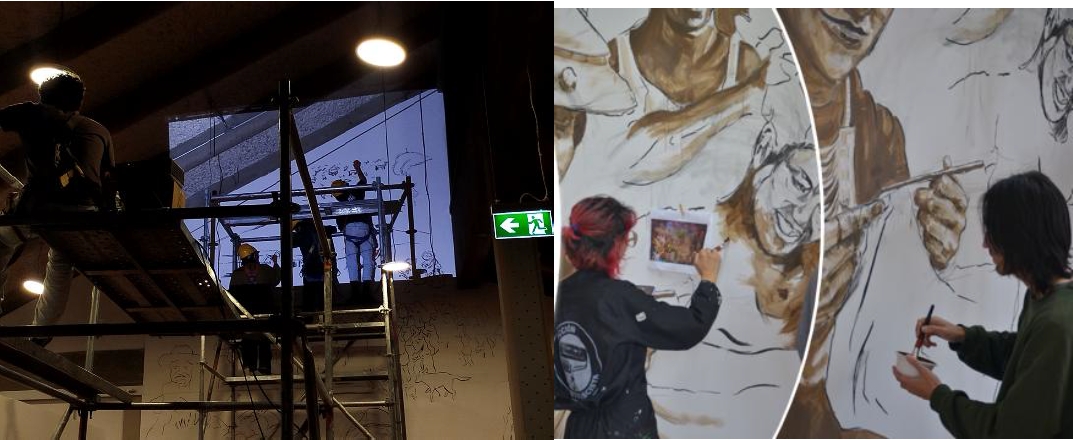
Creating the collective mural “Poemas para no olvidar” -Poems against oblivion- (2025), at the National University of Colombia, brought together the voices, experiences, knowledge, and actions of young university students. It also involved the participation of those who experienced the trauma of forced displacement, in dialogue with those who are emerging and embracing their identity as artists. The mural, as a collective construction of peacebuilding action, is the embodiment of the profound relationship that connects art, memory, polyphony (c.f. Bakhtin, 2013) and symbols of visual culture to, through practice, manage forms of artistic expression capable of consolidating collective memories, identities, and the projection of humanizing futures. This study adopts the framework of Multimodal and Multimedia Critical Discourse Studies (MMCDS), centered on the semiotic axis to explore, from combined theoretical perspectives, how collective memory is questioned, constructed, safeguarded, and transformed through murals, as an expression capable of visually representing indexes, iconologies, and symbols that materialize in art. The analysis takes into account the framework of collective memory, peace action, and participatory art.
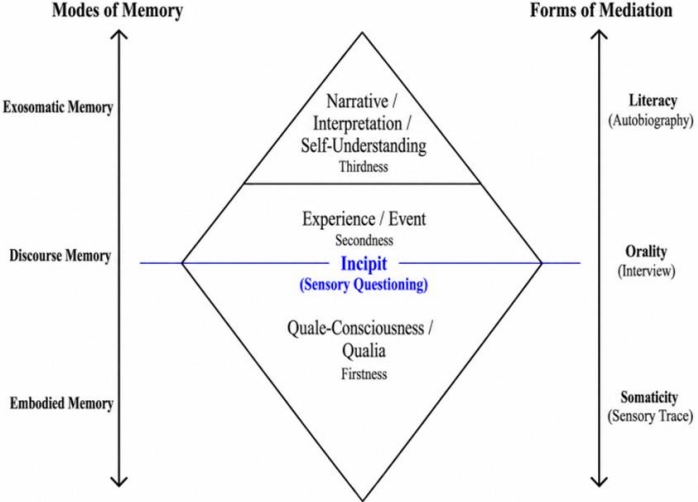
This paper argues that the silence of the elderly does not indicate memory loss; rather, it may be the threshold of memories that have not yet found their voice. The study proposes the concept of “Memory Incipit” as a theoretical framework, based on Charles Sanders Peirce’s concepts of qualia and quale-consciousness. This concept delineates the moment prelinguistic embodied memory first becomes speech through silence, hesitation, fragmentary utterances, repetition, and place-related words. Using a series of autobiographical interviews conducted with five low-income elderly individuals, this study reveals that their memories frequently manifest not as chronological events or causal narratives, but rather as bodily sensations, the atmosphere of a place, and sensory and emotional traces condensed within brief utterances. Sensory questions facilitate the translation of these traces into verbal expression. Therefore, incoherent speech and fragmented utterances do not signify failures in the act of narration. Rather, they represent the initial phase in meaning-making whereby embodied memory becomes speech. The study aims to explore the potential of “Memory Incipit” as a framework for understanding the narrative identity of older adults with limited literacy and opportunities for self-narration.
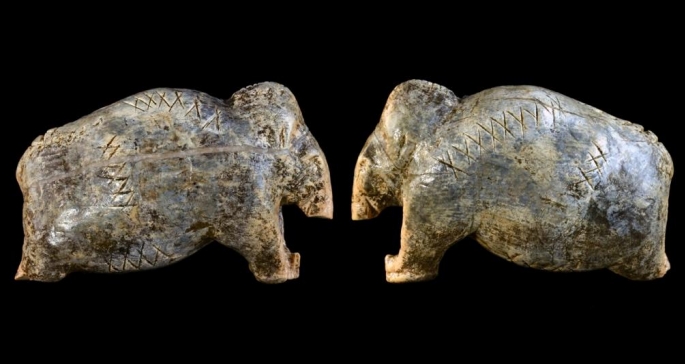
This study proposes an anthroposemiotic theory of prehistoric writing, moving beyond the traditional view that script emerged purely from administrative needs in early Mesopotamian civilizations. Instead, it intends to demonstrate that writing’s deepest roots may lie within the graphic and ritual practices of the Upper Palaeolithic. Approaching early humanity as Homo symbolicus, this study explores how cave art, geometric signs, and monumental architecture may have functioned as exosomatic memory and sacred mediation. Drawing on archi-écriture and spatial syntax, the research shows that prehistoric marks organized spatial relations and structured symbolic ecosystems long before their formalization into phonetic scripts. Ultimately, writing’s genesis can be situated within a broader cognitive evolution, where symbolic exteriorization transformed natural surfaces into durable spaces of meaning.


 First
First Prev
Prev