


• Contact us
  • E-Submission
ABOUT
BROWSE ARTICLES
EDITORIAL POLICY
FOR CONTRIBUTORS

Page Path

10
results for

"art"

Filter

Article category

Keywords

Publication year

Authors

Funded articles

"art"

Articles
The Apartment as Semiosphere and the Untranslated Dread: Rewriting K-Dystopia through Concrete Utopia (2023)
Heeyeon Kim, Jin Young Lee, Haerin Shin
EPISTÉMÈ 2026;39:6.   Published online September 30, 2026
DOI: https://doi.org/10.38119/cacs.2026.39.6
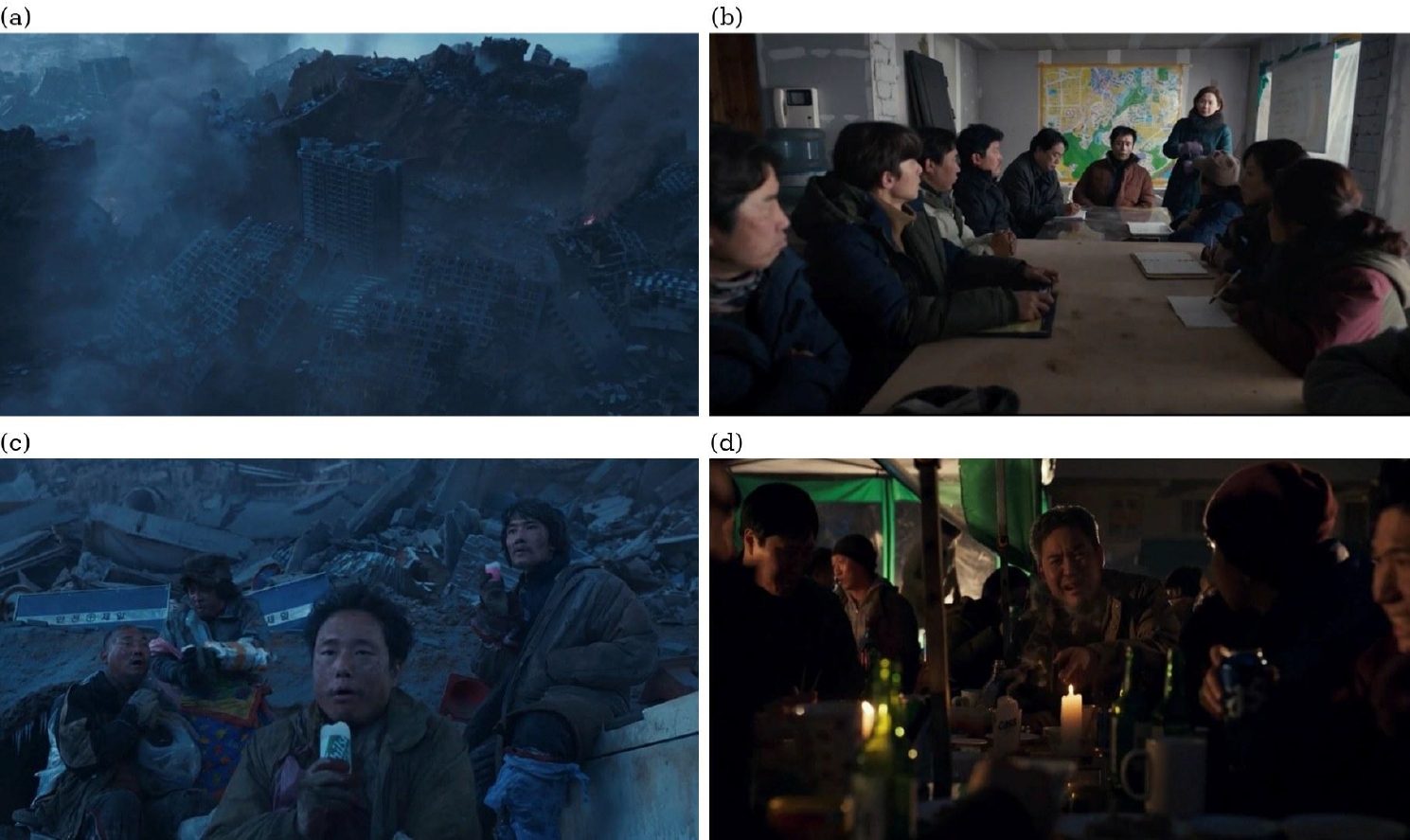
This article analyzes Um Tae-hwa’s Concrete Utopia (2023) through Yuri Lotman’s concepts of spatial modelling, boundary, and the semiosphere, to elucidate how the sign of the apartment constitutes dread within Korean society and to submit the discourse of K-dystopia to critical scrutiny. Reading that discourse as a mode of self-description reorganized under the conditions of transnational circulation and global-platform legibility after the global success of Squid Game (2021), the study attends to the local surplus that such naming fails to carry across, declining nonetheless to consign it to the untranslatable. Two movements compose the argument. Beyond the film, the specificity of the Korean apartment is bound to the discourse of K-dystopia so as to disclose a dread that circulation leaves untranslated; within the film, scene analysis traces the visual codification of interior against exterior, the graduated nullification of the other, and the closure of the boundary through the ossification of self-description. Diegetic exclusion and discursive subsumption prove to be a single semiotic operation nested at two magnitudes, a matryoshka isomorphism in which the recurring unease articulated in Korean viewer reviews may be read as registering the homology of the two. Untranslated dread, so situated, opens onto a productive site of reappropriation and emergence.
  • 189 View
  • 12 Download
Polyphonic Aesthetics: Towards a Technopoetry and Sound Poetry Within Expanded Art
Ruth Vigueras Bravo
EPISTÉMÈ 2026;39:5.   Published online September 30, 2026
DOI: https://doi.org/10.38119/cacs.2026.39.5
This study explores the polyphonic diversity of technopoetry and sound poetry, tracing their evolution within the expanded field of contemporary art. The 20th century was notably characterized by avant-garde movements—such as Dadaism, Surrealism, Russian Constructivism, Situationism, and Futurism—that influenced the poetic techno-scene. Some notable movements include Fluxus, the happening, and post-punk. These were movements that set powerful trends, finding new avenues of expression—hybridization, transgression, rupture, and the liminal space between the body and the artistic medium—within a constant flow that takes on a philosophical, aesthetic-political-social, and visual construct. Through the incorporation of diverse media and the use of technology, the work acquires a new symbolic dimension, one that originates in poetry and music. This essay briefly explores the symbolic nature of technopoetry and its relationship to related subgenres: experimental, concrete, sound, electronic, and semiotic poetry, as well as videopoetry, holopoetry, and performance poetry. Thereby prompting an examination of the future of poetry and the arts within the context of the 4.0 revolution and the technological convergence involving artificial intelligence and big data.
  • 248 View
  • 23 Download
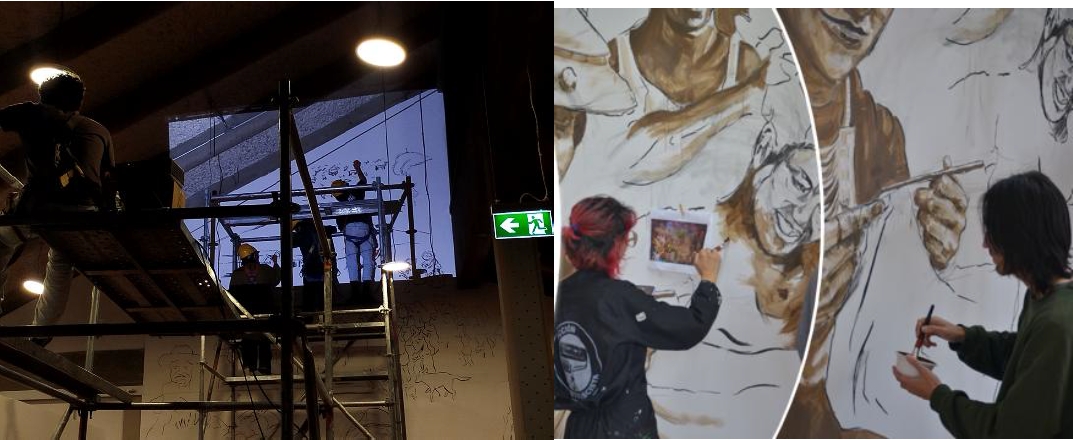
Creating the collective mural “Poemas para no olvidar” -Poems against oblivion- (2025), at the National University of Colombia, brought together the voices, experiences, knowledge, and actions of young university students. It also involved the participation of those who experienced the trauma of forced displacement, in dialogue with those who are emerging and embracing their identity as artists. The mural, as a collective construction of peacebuilding action, is the embodiment of the profound relationship that connects art, memory, polyphony (c.f. Bakhtin, 2013) and symbols of visual culture to, through practice, manage forms of artistic expression capable of consolidating collective memories, identities, and the projection of humanizing futures. This study adopts the framework of Multimodal and Multimedia Critical Discourse Studies (MMCDS), centered on the semiotic axis to explore, from combined theoretical perspectives, how collective memory is questioned, constructed, safeguarded, and transformed through murals, as an expression capable of visually representing indexes, iconologies, and symbols that materialize in art. The analysis takes into account the framework of collective memory, peace action, and participatory art.
  • 186 View
  • 11 Download
Prolegomena to an Anthroposemiotic Theory of Prehistoric Writing
Sung Do Kim, Seungjoon Cho
EPISTÉMÈ 2026;38:4.   Published online June 30, 2026
DOI: https://doi.org/10.38119/cacs.2026.38.4
This study proposes an anthroposemiotic theory of prehistoric writing, moving beyond the traditional view that script emerged purely from administrative needs in early Mesopotamian civilizations. Instead, it intends to demonstrate that writing’s deepest roots may lie within the graphic and ritual practices of the Upper Palaeolithic. Approaching early humanity as Homo symbolicus, this study explores how cave art, geometric signs, and monumental architecture may have functioned as exosomatic memory and sacred mediation. Drawing on archi-écriture and spatial syntax, the research shows that prehistoric marks organized spatial relations and structured symbolic ecosystems long before their formalization into phonetic scripts. Ultimately, writing’s genesis can be situated within a broader cognitive evolution, where symbolic exteriorization transformed natural surfaces into durable spaces of meaning.
  • 811 View
  • 16 Download
The Violence of Thinking: Healing through the Contemplative Seeing of the World
Yvonne zu Dohna Schlobitten
EPISTÉMÈ 2026;37:6.   Published online March 31, 2026
DOI: https://doi.org/10.38119/cacs.2026.37.6
The topic of violence and art can be viewed from many perspectives, from the depiction of violence to people who inflict violence on art. Here, the focus is on the ‘violence in our thinking’. Can one's thinking inflict violence on things? Can cold, scientific thinking, thinking in prejudice, or ideological thinking inflict violence on works of art? Here, we address how this happens and how one can confront this violence against works of art. How can it be healed? Through this, the difference between the violence of Thinking and Thinking as a Battle will be explained. At the center of this argument, we discuss the Contemplative Seeing of the World (Welt-Anschauung) which enables an honest seeing. This means becoming friends.
  • 656 View
  • 12 Download
Artificial Intelligence for Intelligent Road Communication: Systems and Strategies in Cameroon
Myriam Josette Nken
EPISTÉMÈ 2025;36:46-59.   Published online December 31, 2025
DOI: https://doi.org/10.38119/cacs.2025.36.3
Road safety in Cameroon remains a major concern, with thousands of deaths and significant economic losses recorded annually. Traditional road communication strategies have shown limited effectiveness, revealing a gap between the messages disseminated and their appropriation by road users. In this context, artificial intelligence (AI) emerges as a strategic resource to rethink prevention and traffic regulation. Intelligent Transport Systems (ITS) and digital tools such as navigation applications, smart sensors, and connected vehicles provide new opportunities for interactive, predictive, and adaptive communication. The study adopts an empirico-inductive methodology based on observation, documentary analysis, and international comparison. The theoretical framework combines Shannon and Weaver’s mathematical theory of communication, Habermas’s theory of communicative action, Crozier and Friedberg’s sociology of regulation, and ITS approaches. The analysis highlights both media and non-media strategies, while demonstrating the concrete contributions of AI to traffic fluidity, accident reduction, and road governance. It concludes with the challenges and prospects of implementing intelligent road communication adapted to the Cameroonian context.
  • 1,345 View
  • 67 Download
Semiotics of Fashion: Desire and Resistance, All Things Considered
Giulia Adriana Ceriani
EPISTÉMÈ 2025;34:2.   Published online June 30, 2025
DOI: https://doi.org/10.38119/cacs.2025.34.2
This reflection aims to explore the foundations, limitations, and necessity of fashion semiotics, beyond the inertia that still binds it to a mere reinterpretation of Barthesian legacy. On the contrary, fashion semiotics reveals its compelling and contemporary relevance when it is considered in light of the explanatory power granted to a language too often relegated—for commercial reasons or societal conventions—to a marginal or reductionist role, rather than being acknowledged as an active part of present-day expression in all its forms. These include, notably, gender relations, political implications, the dynamics of possible and impossible relations in the context of digital interfaces, the dialectic between conjunctive tensions and the condemnation to disjunction. Desire and resistance will be the two key terms guiding us through this unaligned reinterpretation.
  • 1,527 View
  • 34 Download
AI and the sacred: an anthropological approach
Emmanuel Carré, Pascal Lardellier
EPISTÉMÈ 2025;33:7.   Published online March 31, 2025
DOI: https://doi.org/10.38119/cacs.2025.33.7

This two-part article analyzes the ancient and mystical origins of artificial intelligence (AI). First, it explains that AI has precedents in mystical thought and finds relevance in certain anthropological concepts. Next, we'll look at how ancient philosophy has helped to explain in advance the way in which we - and in particular students - use artificial intelligence as a “mental orthosis”.

  • 4,054 View
  • 68 Download
Artificial Intelligence in Healthcare: A Holistic Approach for Successful, Human-Centered Implementation
Emmanuel Carré, Marjorie Garofalo
EPISTÉMÈ 2025;33:6.   Published online March 31, 2025
DOI: https://doi.org/10.38119/cacs.2025.33.6

The integration of Artificial Intelligence (AI) in the healthcare sector represents a major transformation that raises complex issues concerning the technical, organizational, and relational dimensions of the profession. This contribution analyzes the key success factors and obstacles to the implementation of AI in healthcare facilities, adopting a holistic perspective that emphasizes communicational and interprofessional dynamics. Through an analysis of recent literature, we identify promising approaches and necessary conditions for successful AI integration, while preserving the quality of caregiver-patient relationships and interactions among professionals. Our analysis reveals that successful implementation relies on a balanced combination of leadership, end-user training, support for teams in modifying their daily work, and ethical governance. The central role of communication in this transformation process is emphasized, both in change management and in the adaptation of professional practices. We propose recommendations that integrate these different dimensions to guide the development and implementation of AI projects in healthcare, focusing on preserving and enriching human relationships within healthcare organizations.
  • 1,175 View
  • 28 Download
Machination: Semiotics of IArt. Dance and Artificial Intelligence
José María Paz Gago
EPISTÉMÈ 2025;33:3.   Published online March 31, 2025
DOI: https://doi.org/10.38119/cacs.2025.33.3

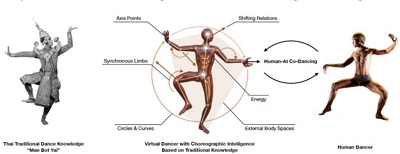
Multimodal generative Artificial Intelligence is an omnipresent technology in our post-industrial societies, as it has penetrated all areas of daily life, from social and commercial relations to the various fields of science and industry, communication, leisure and culture in general. This is to discuss whether AI is applicable to the field of artistic creation in general and to bodily arts such as dance in particular, taking into account emotional sensitivity and creativity, factors that are difficult to generate by a machine. In this article we will discuss examples of corporal artistic manifestations, in the domain of dance, in which corporality itself is called into question in the face of these interactions with humanized bodies conceived, created and “brought to life” by the magic of generative AI. The learning models developed by different Artificial Intelligence software allow these bodies to dance, model or evolve in scenographic spaces created ad hoc and shared to the point of replacing real dancers.

  • 2,111 View
  • 26 Download
TOP