This is an Open Access article distributed under the terms of the Creative Commons Attribution Non-Commercial License (https://creativecommons.org/licenses/by-nc/4.0/) which permits unrestricted non-commercial use, distribution, and reproduction in any medium, provided the original work is properly cited.
This article examines how social robots, or “bots,” have transformed online interactions and information manipulation, particularly on the platform X (formerly Twitter). It retraces their socio-historical evolution—from early chatbots like ELIZA to AI-driven agents capable of realistic human mimicry. Drawing on the Beelzebot research project, the paper proposes a classification of “malicious” bots according to their technical sophistication, intentionality, and interaction strategies. These bots amplify, polarize, and distort public debate through mechanisms such as astroturfing, fake engagement, and echo-chamber exploitation. The integration of generative AI has produced a new generation of adaptive, persuasive “AI bots” blurring human-machine boundaries. The article highlights how these entities shape information flows, foster disinformation, and undermine trust in institutions. It argues for a socio-technical “archaeology” of bots to understand their evolving power in digital public spaces. Finally, it calls for new multidisciplinary tools—technical, educational, and regulatory—to preserve the authenticity of social interaction and democratic deliberation in the AI era.
Social networks such as X, TikTok and Instagram have become an integral part of our digital environment. Their social use is an integral part of users' daily lives. Originally, the aim of these social networks was to make it easier for people to connect by exchanging messages and sharing moments in their lives, while staying in touch with their social neighbours. Today, their use goes well beyond this initial intention, and raises multiple issues linked, among other things, to the online instrumentalisation of interactions for the benefit, for example, of disinformation and the influence of public opinion. We are then witnessing a diversion of use (Perriault, 2009) facilitated by social robots ("bots" or "social bot") whose role is particularly ambiguous in transforming the dynamics of online interaction. Initially conceived as simple automated scripts, these bots have evolved to become complex and often undetectable actors. The recent development of artificial intelligence reinforces this undetectability, with social robots capable of demonstrating human mimicry, blurring even further the boundaries between what is true and what is false and facilitating the active manipulation of public debate.
Since it was bought by E. Musk and deregulation was introduced, the social network X (formerly Twitter) has been a prime observation ground for these transformations. According to X1, this platform will have more than 11 million active users per month by 2023 in France. It has become a key player in the production and distribution of news in real time, playing the role of a press agency in France. Beyond this 'simple' media relay (Brachotte & Frame, 2015; 2016), the social network X operates within a polymedia logic (Madianou & Miller, 2013) in which the dynamics between traditional media, digital platforms and online interactions shape the circulation of information, activism and exchanges of ideas or opinions. In this media ecosystem, social robots play a role in enabling actors to gain influence and spread manipulated information (fake news) without the knowledge of users or even the traditional media. The scale of the phenomenon is undeniable. Numerous studies have highlighted the massive use of robot armies (Besel & al., 2018). Their presence and potential influence have been observed during high-profile political events such as the 2017 French presidential elections (Ferrara, 2017; Frame & al., 2021), the 2016 US elections (Bessi and Ferrara, 2016; Kollanyi, 2016; Bovet & al., 2019; Grinberg & al, 2019) or the 2017 German federal elections (Brachten & al, 2017; Boichak & al., 2021). Their impact extends beyond the electoral framework to sensitive geopolitical contexts, such as the Syrian civil war (Abokhdair & al., 2015) and the Russian-Ukrainian conflict since 2015 (Hegelich and Janetsko, 2016; Mejias & al., 2017; Golovchenko & al., 2018; Smart & al, 2022; Ciuriak & al., 2022). In addition to the political sphere, bots were also very active in the healthcare field during the COVID-19 crisis, which was marked by disinformation campaigns orchestrated by bots around vaccination and the effects of messenger RNA with the aim of influencing public opinion (Gallotti & al., 2020; Himelein & al., 2021; Broniatowski & al., 2018). Lastly, this mass manipulation can be found in the financial sector, where Cresi & al. (2020) reveal that nearly 71% of accounts mentioning US stocks on X are generated by bots.
Our aim in this article is to show how the evolution of social bots has profoundly altered the nature of online interactions and redefined the dynamics of information manipulation. Based on the 'Beelzebot2' research project, we propose to present the evolution of bots and establish a classification of 'malicious' social robots, while identifying the manipulation strategies deployed in the French Xsphere. We will also highlight their impact on the circulation and dissemination of information in a post-truth era leading to new disinformation mechanisms reinforced by the development of artificial intelligence.
2. Archaeology of social robots: a socio-historical evolution
To fully understand the current issues surrounding social robots and their impact on online interactions, it is not enough to document the artefacts; we need to analyse the socio-technical conditions of their emergence, their inclusion in media regimes and their relationship to contemporary practices. It is important to have a vision of a technological, cultural and economic continuum, so as not to give in to a presentist vision that would de facto isolate social robots from this dynamic. We therefore propose to distinguish five key periods in the evolution of bots and online interactions, taking into account: 1) the progression of technical capabilities, 2) the evolution of contexts of use, 3) the diversification of social functions and, finally, 4) the gradual emergence of ethical and societal issues. The first period began in the 1960s with the first experiments with conversational artificial intelligence, "ELIZA", created by J. Weizenbaum. This was a conversational agent that simulated a human conversation using simple algorithmic pattern-matching rules. This chatbot had no real understanding of language, but it laid the foundations for the “anthropomorphisation” of machines by showing the extent to which people projected onto machines an intelligence that they did not have. Several paradigms of human-machine interaction were then put in place: the illusion of understanding techniques, the simulation of empathy (as in the DOCTOR script3) and the psychological projection of users onto an artificial entity. The second period was, in our view, the 1990s, when the first real social bots emerged with the advent of IRC (Internet Relay Chat) channels. This was a significant development4, as these bots operated in a multi-user social context and acted as community mediators, moderating digital communities and welcoming new members while regulating communities according to defined rules. The third period corresponds to the development of social platforms such as Twitter and Facebook, which created a new field of experimentation for the social bots we know today. We are witnessing a diversification in the types of bots (informative, creative, service and already malicious) that exploit the open architecture of the platforms and their APIs. They are becoming more socially engaging and are already transforming the information ecology. The fourth period corresponds to the integration of machine learning and natural language processing technologies from 2016 onwards. One of the most striking examples is Microsoft's Twitter bot "Tay", which learns from its interactions, but the experiment quickly turns into a disaster when it is manipulated into adopting toxic behaviour. This led to the misuse of bots, particularly during the 2016 US elections, revealing the existence of coordinated networks of propagandist bots intent on shaping public debate. This period shows how vulnerable digital spaces are to algorithmic manipulation and raises questions about the ethics of using technology. Finally, the last period is the one we have been observing since 2022, with the massive development of major language models such as GPT. Bots are becoming more conversational and creative. They blur the boundary between human and artificial presence. They are no longer "simple" automated agents, but sophisticated social mediators that significantly influence the interactional, communicational and emotional dynamics of digital platforms.
3. Classification and strategies of "malicious" social robots in the AI era
3.1 Definitions
Before we can typologise social robots, we would like to give our definition5, as the notion is complex and mobilises a multidisciplinary approach and concepts developing specific theoretical foundations, which accentuates terminological confusion (Stieglitz et al., 2017).
A social bot is a computer algorithm that automatically produces content and interacts with human accounts on social networks (Ferrara et al., 2016). These inauthentic accounts are deployed on X to act on the information environment to influence public opinion (Kitzie et al., 2018) with varying degrees of sophistication (Abokhodair et al., 2015). Most social robots are characterised by behavioural mimicry (Glassey, 2017), which refers to behaviours aimed at mimicking human accounts (Stieglitz et al., 2017). They can take the form of botnets, i.e. a set of bots driven by a botmaster that coordinate and collaborate with the aim of influencing the direction of discussions and the topics put forward on the platform (Abokhodair et al., 2015), and amplifying specific content through coordinated actions (Ferrara, 2022; Mazza et al., 2022).
3.2 Classification of “malicious bots”
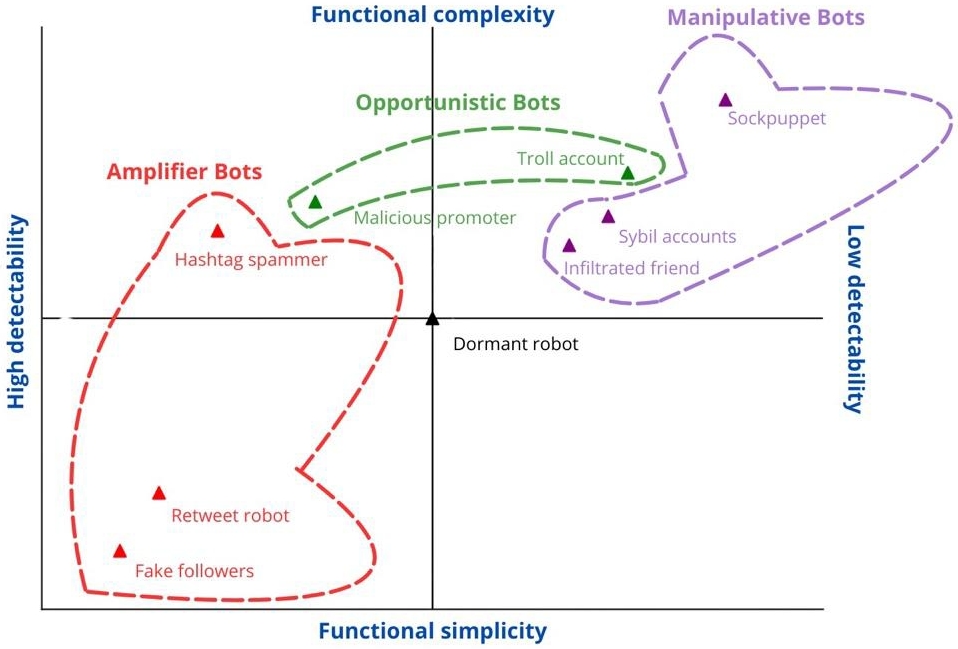
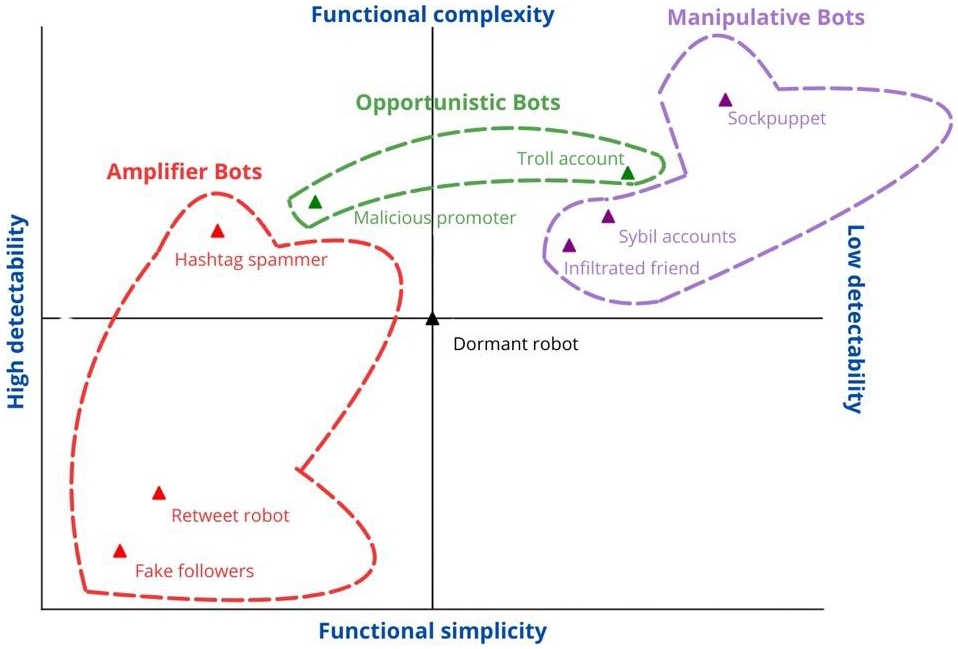
In this section, we focus solely on 'malicious' robots, effectively ruling out benign and neutral robots (Stieglitz et al., 2017). This bias stems directly from the intrinsic objective of the Beelzebot research project, which aims, among other things, to highlight information manipulation strategies. As illustrated in Figure 1, we propose an axiology and classification of bots based on three dimensions: a) their technical sophistication and ability to imitate human behaviour (Boshmaf et al., 2013), b) their intentionality (Ferrara et al., 2016) which ultimately determines their degree of detection in information manipulation strategies, and c) their mode of interaction with the user. This last dimension is fundamental because it is through the interactions produced that a bot's ability to manipulate and influence (or even mislead) public opinion is determined.
This classification highlights the fact that the more sophisticated a bot is (in terms of functionality), the harder it is to detect because its behaviour is closer to that of a human. This view is reinforced by the vertical axis, which refers to the "power stakes" identified in bots. As we saw above (historical evolution), some robots were designed for "legitimate" uses, such as broadcasting weather information or automating services via chatbots. Others, on the other hand, have been deployed with the explicit aim of manipulation by exploiting the cognitive biases and credulity (Bronner, 2013) of users. This approach highlights the fact that social bots are never totally neutral (Merzeau, 2017) and that they help to manipulate collective memory online. They convey values and intentions that are specific to their designers.
Let's go back to the classification. This is centred around the "dormant" robot, whose functionality and intention are not yet visible, even though they have been determined. In the zone of functional simplicity, we will find "elementary" robots such as "fake followers" or "retweeters" whose level of automation is very basic and easily identifiable. The former are often sold on online markets (Cresci et al., 2015) and serve only to artificially boost the number of subscribers to an account. The latter simply retweets specific content automatically, based on defined criteria (Mittal, 2014). These bots, known as "amplification bots", are particularly "noisy" because they generate a large volume of messages in an attempt to saturate the digital public space. They bring into play a mechanism for amplifying information by using the social and technical logic of the device in the image of the hashtag under X. Their impact is immediate, based more on the quantity of information than the quality of information and interaction. In this space we also find "duplication spammers" whose overall objective remains the same, namely, to flood the information space with virtually identical content using mention systems. This functional logic makes navigation more complex and skews the visibility of messages. The proposed representation shows that bots' strategies evolve as a function of their functional complexity. As functional sophistication increases, bots' strategies become more subtle and their 'artificial' interactions with users more difficult to detect. This zone of high functional complexity and low detectability includes bots that develop advanced interaction strategies that enhance their ability to deceive users, such as "infiltrated friends". These build credible profiles and exploit the dynamics of human interaction on X to extend their influence before engaging in massive manipulation. Still in this complex zone, we find even more insidious bots that do not flood the digital public space but play on their identity (such as "false noses" and "sybilles doppelgänger"), usurp existing identities or create new ones that allow them to blend into social networks and interact with users discreetly (Bastos & Mercea, 2017; Goga et al., 2015). These bots operate discreetly by imitating human behaviour and seek to engage in individualised and credible interactions to better deceive the user.
Finally, the central zone groups together bots that we have called 'opportunistic'. They alternate between phases of mass distribution (like amplifier bots) or targeted distribution and intervention. Bots in this zone may remain 'dormant' for a long period before adopting more active behaviour.
This classification and axiology highlights a major, even worrying, difficulty for users: the difficulty of spotting and distinguishing 'genuine', human interaction from algorithmic manipulation. Users find themselves in an "unstable" and "uncomfortable" situation, forcing them to refine their vigilance strategies in order to discern the "real" from the "fake". Beelzebot is also about enabling Twittos to detect the mechanisms and logic used on X for manipulative purposes.
3.2.1 The impact of artificial intelligence on robot functionality
The new social robots that we call "AI robots6" incorporate new technical and social logics that make their archaeology more complex. These "evolving malicious" bots are accentuating the transformation of interactions within the digital public space by making human and artificial boundaries more porous. They are now more stealthy and capable of imitating human behaviour in real time to interact more naturally and adaptively. To do this, they demonstrate a triple mechanism resulting from dynamic contextualisation, personalisation of the exchange and the ability to generate creative content. This ability clearly differentiates them from "traditional" bots, which simply reproduce pre-formatted content. This evolution has been made possible by the development of generative AI based on deep learning, such as GPT7 from openAI. This technique, like other LLMs8, gives "AI robots" a functional autonomy that depends on the social signals they perceive (Dautenhahn, 2007). For example, during the American presidential elections in 2020, social robots were able to adapt their speech according to conversational situations (Luceri et al., 2020). These robots already had advanced writing functionalities and also temporal response logics resembling human behaviour (Ferrara, 2020). These developments are particularly worrying in the digital public space, where these 'intelligent' automated agents insidiously insert themselves into polarised groups in order to represent the ideological nuances of the same political spectrum (Starbird et al., 2019). To do this, they exploit human cognitive biases, in particular confirmation bias, to present information ideologically aligned with the perceived preferences of their targets. This creates an emotional mimicry and an "illusory cognitive proximity" (Gonzalez-Baillon et al., 2021) where the user perceives the bot as an ideological ally. This personalisation of interaction exposes the user to "made-to-measure" content that is more engaging. AI bots" are ultimately endowed with a power of persuasion capable of influencing opinions and behaviour on a large scale through well-defined manipulation strategies that we present below.
4. From amplification to astroturfing: the arsenal of "malicious" bots
We have already explained how "malicious" social robots operate in the dynamics of disinformation. The strategies deployed can therefore be found in the intrinsic functionalities of these robots. They mobilise complex, interconnected mechanisms to manipulate and shape the perceptions of Internet users, or more specifically, in our analysis, those of Twittos. The first major axis of this manipulation lies in the bots' ability to artificially amplify the reach and audience of certain entities. Bots are programmed to generate massive numbers of online interactions such as likes, shares and comments. The high number of interactions then creates an impression of (fake) popular enthusiasm around ideas or personalities and reinforces the credibility of the information perceived. This phenomenon was well described by C. Hovland in his research on persuasion. The second mechanism lies in the ability of bots to polarise discussions and intensify the divisive nature of certain subjects. They can, for example, exacerbate the polemical aspects of a debate, as they did during the French presidential elections in 2022. To do this, bots automatically post virulent comments or relay highly polarising messages. This process leads to the fragmentation of communities by deepening differences. It should also be noted that this type of behaviour is classically found in more "classic" political strategies, where "human armies" of activists use the same methods. So it's not unique to social robots, which simply reproduce logic that used to exist in political campaigns, but which has been facilitated by technology and its use. The third mechanism lies in the bots' ability to maintain informational chaos. To this end, bots actively propagate "fake news", rumours and contradictory accounts. The aim is to sow doubt and confusion so that Twittos are no longer able to discern truth from falsehood, but also to undermine trust in institutions and the media. A fourth mechanism is astroturfing, which consists of simulating popular support by creating fake X accounts. The aim of the bots is to create a mass effect of supporters who believe that a majority supports an idea. This false impression of bogus digital popularity makes it possible to rally individuals to the manipulated opinion. This phenomenon is known as the bandwagon effect (Klapper, 1950).
Lastly, these manipulation strategies take place in compartmentalised digital public spaces under the effect of techno-social actions such as "filter bubbles" (Pariser, 2011) and "echo chambers" (Sunstein, 2009). Robots know perfectly well how to exploit these effects. Bots will amplify echo chambers by targeting specific communities that are exposed only to similar opinions. What's more, they will take advantage of the functional logic of algorithms that unconsciously lock platform users into content that corresponds to their preferences. While the echo chamber phenomenon is based on a social logic (individuals choose to follow and engage with people who share their opinions), the filter bubble mechanism is based on a technical logic. Users are not necessarily aware that the information to which they are exposed comes from the analysis of their use of the platform (browsing, clicks, interactions, etc.). The strength of these logics lies in their complementary role in creating vicious circles of radicalisation. Both phenomena lead to cognitive isolation, reinforcing existing beliefs and reducing exposure to a diversity of opinions and/or information.
5. Conclusion
The evolution of bots, from simple automated scripts to complex entities capable of simulating human behaviour, illustrates the technological advances and ethical challenges associated with their use and presence in the digital public space. This technological progress, linked more specifically to the implementation of artificial intelligence, is transforming the logic of interactions with technologies and with each other on digital platforms. The observations we made above show that the archaeological analysis of robots is not limited to a historical description, but is based on a trajectory of socio-technical use. What's more, digital platforms like X don't just reflect existing social trends. They are helping to shape social realities by creating new forms of expression, sociability, visibility and invisibility. By virtue of their technical architecture, their algorithms and their functionalities, these socionumeric devices perforate the social. Social robots and AI reinforce this performativity by setting up interaction frameworks that can guide public opinion and constrain or even simulate social behaviour. There is, therefore, a socio-technical mediation that can be exploited by "malicious" robots to influence our behaviour, perceptions and decisions. Today, this meditation is increasingly vulnerable under the impact of these robots and AI, which enclose users in increasingly personalised and compartmentalised information environments where each person finds and locks themselves into their own reality. This leads to increased fragmentation of discussion spaces, where each user is exposed to tailored content that reinforces echo chambers and filter bubbles. In this context, technology is having a direct impact on our social practices, the media agenda and the spread of post-truths, all of which find themselves in the 'grip' of the consequences of digital platform algorithms (recommendation, ranking and filtering systems).
This creates feedback loops that affect and shape our social practices and, more broadly, democratic debate. The device is not excluded from this process; it even plays a central role as it standardises usage via its interface and functions (like, comment, RT). Robots and AI make effective use of these logics and "loopholes" by exploiting the intrinsic possibilities of the device but also the organic properties of the network built by users to produce an artefact of human interaction and potentially manipulate public opinion. We are witnessing a digital paradox linked to the name given to so-called "social" robots. While their inventors may have intended them to have a social vocation, i.e. to interact and cohabit with humans in an emotional, communicative and collaborative way, we can only observe that, like other techniques, within X we are witnessing a diversion of use (Perriault, 2008) to the benefit of manipulation and disinformation. These 'malicious' bots embody a profound and problematic transformation of our social interactions. The communicative process, in which algorithmic simulation gradually replaces authentic interaction, impoverishes our exchanges by reducing them to calculated strategies of production and influence. Empathy is replaced by efficiency, and dialogue becomes a controlled one-way flow of content. This is leading to a gradual dehumanisation of digital public spaces such as X, where distrust and the alteration of our social interactions reign supreme. Malicious" robots have a single objective: to manipulate information by generating noise and mistrust in order to influence public opinion and, de facto, the process of collective deliberation. AI accelerates this mechanism by being capable of mass-producing synthetic content in the form of text, images and videos (including deepfakes), blurring the lines between the fake and the real even further. The archaeology of social robots must therefore adapt to this reality of new forms of artificial presence in order to preserve the authenticity of our social interactions and democratic debate. Ultimately, it is our very conception of communication, democratic debate and sociability that is being called into question. A detailed understanding of these mechanisms of influence is therefore essential if we are to preserve the integrity of public debate in the digital age. This requires us to rethink our models of analysis and intervention by developing new tools (as the Beelzebot project aims to do) and new approaches that combine technological advances, media education and changes in regulatory frameworks.
Finally, the archaeology of social robots in the age of AI highlights a major challenge of our time, namely the need to preserve the authenticity of human interaction in a digital public space dominated by the hyper-production of disinformation underpinned by algorithmic techniques that also underpin an economy of attention on digital platforms. Any archaeological studies in this field therefore require a multi-disciplinary approach in order to understand the dual nature (technical and social) of a social robot and AI. This is the approach developed within the Beelzebot research project, which provides the framework for the analysis in this article.
2 The "Beelzebot" project (ANR-23-CE38-0002-01, www.beelzebot.fr) is the winner of the ANR 2023 generic call. Led scientifically by G. Brachotte, its main objective is to develop the first French system capable of highlighting the strategies used by armies of robots to manipulate information in the French Xsphere.
3 ELIZA's DOCTOR script imitated a psychotherapist. It rephrased the user's words in the form of open-ended questions, giving the illusion of genuine understanding.
4 This recalls IRC bots such as "Eggdrop", "buddy bots" and "SmaterChild" in the 2000s.
5 These definitions and typology are a summary of the collaborative work carried out within the Beelzebot project, in particular by Nathan Bourgoing, who did a placement with the research team during his Masters 2 in Language Sciences at the TIL laboratory of the Université Bourgogne-Europe.
6 By this we mean robots that have a software layer that complements the existing one. So our proposed classification remains unchanged, but the most advanced functionalities will be enhanced by the 'strength' of artificial intelligence.
7 Generative Pre-trained Transformer is a family of natural language processing models developed by OpenAI.
8 Many Large Language Models are currently being developed. These include, but are not limited to, Mistral Ai, Gemini and Claude.
Figure 1.
Malicious bot classification and strategy
REFERENCES
Abokhodair, N., Yoo, D., & McDonald, D. W. (2015). Dissecting a Social Botnet: Growth, Content and Influence in Twitter. In Proceedings of the 18th ACM Conference on Computer Supported Cooperative Work & Social Computing.
Bastos, M. T., & Mercea, D. (2017). The Brexit Botnet and User-Generated Hyperpartisan News. Social Science Computer Review, 37(1), 38-54. https://doi.org/10.1177/0894439317734157
Besel, C., Echeverria, J., & Zhou, S. (2018, August). Full cycle analysis of a large-scale botnet attack on Twitter. In 2018 IEEE/ACM International Conference on Advances in Social Networks Analysis and Mining (ASONAM) (pp. 170-177). IEEE.
Bessi, A., & Ferrara, E. (2016). Social bots distort the 2016 U.S. presidential election online discussion. First Monday, 21(11), https://doi.org/10.5210/fm.v21i11.7090
Boichak, O., Hemsley, J., Jackson, S., Tromble, R., & Tanupabrungsun, S. (2021). Not the Bots You Are Looking For: Patterns and Effects of Orchestrated Interventions in the U.S. and German Elections. International Journal of Communication, 15814-839.
Boshmaf, Y., Muslukhov, I., Beznosov, K., & Ripeanu, M. (2013). Design and analysis of a social botnet. Computer Networks, 57(2), 556-578. https://doi.org/10.1016/j.comnet.2012.06.006
Brachotte, G., & Frame, A. (2015). L'usage de Twitter par des journalistes politiques français: un outil de recomposition de la pratique professionnelle journalistique?. In La communication électronique: Enjeux, stratégies, opportunités. 125135). Lambert-Lucas.
Brachotte, G., Frame, A., Gautier, L., Nazarov, W., & Selmi, A. (2022). Les discours complotistes sur Twitter à propos de la vaccination contre la Covid-19 en France: Communautés et analyse sémio-linguistique des hashtags. Mots. Les langages du politique, 13079-103. https://doi.org/10.4000/mots.30587
Brachten, F., Stieglitz, S., Hofeditz, L., Kloppenburg, K., & Reimann, A. (2017). Strategies and influence of social bots in a 2017 German state election. ACIS 2017 Proceedings, 90https://doi.org/10.48550/arXiv.1710.07562
Broniatowski, D. A., Jamison, A. M., Qi, S., AlKulaib, L., Chen, T., Benton, A., Quinn, S., & Dredze, M. (2018). Weaponized Health Communication: Twitter Bots and Russian Trolls Amplify the Vaccine Debate. American Journal of Public Health.
Cresci, S., Di Pietro, R., Petrocchi, M., Spognardi, A., & Tesconi, M. (2015). Fame for sale: Efficient detection of fake Twitter followers. Decision Support Systems, 8056-71. https://doi.org/10.1016/j.dss.2015.09.003
Dautenhahn, K. (2007). Socially intelligent robots: dimensions of human--robot interaction. Philosophical Transactions of the Royal Society B: Biological Sciences, 362(1480), 679-704.
Ferrara, E. (2022). Twitter spam and false accounts prevalence, detection, and characterization: A survey. First Monday, https://doi.org/10.5210/fm.v27i12.12872
Ferrara, E., Chang, H., Chen, E., Muric, G., & Patel, J. (2020). Characterizing social media manipulation in the 2020 U.S. presidential election. First Monday, https://doi.org/10.5210/fm.v25i11.11431
Glassey, O. (2017). Repenser la sociologie du numérique à l'aune de notre vie commune avec les robots sociaux. Sociologie et sociétés, 49(2), 59-82. https://doi.org/10.7202/1054274ar
Goga, O., Venkatadri, G., & Gummadi, K. P. (2015). The Doppelgänger Bot Attack: Exploring Identity Impersonation in Online Social Networks. In Proceedings of the 2015 Internet Measurement Conference (pp. 141-153). https://doi.org/10.1145/2815675.2815699
Hegelich, S., & Janetzko, D. (2016). Are social bots on Twitter political actors? Empirical evidence from a Ukrainian social botnet. In Proceedings of the Tenth International Conference on Weblogs and Social Media (pp. 579-582). AAAI Press.
Himelein-Wachowiak, M., Giorgi, S., Devoto, A., Rahman, M., Ungar, L., Schwartz, H. A., Epstein, D. H., Leggio, L., & Curtis, B. (2021). Bots and Misinformation Spread on Social Media: Implications for COVID-19. Journal of Medical Internet Research, 23(5), e26933. doi: 10.2196/26933.
Kitzie, V., Mohammadi, E., & Karami, A. (2018). "Life never matters in the DEMOCRATS mind": Examining strategies of retweeted social bots during a mass shooting event [Data set]. figshare. https://doi.org/10.6084/M9.FIGSHARE.6726419
Kollanyi, B. (2016). Automation, algorithms, and politics: Where do bots come from? An analysis of bot codes shared on GitHub. International Journal of Communication, 104932-4951.
Madianou, M., & Miller, D. (2013). Polymedia: Towards a new theory of digital media in interpersonal communication. International Journal of Cultural Studies, 16(2), 169-187. https://doi.org/10.1177/1367877912452486
Mazza, M., Cola, G., & Tesconi, M. (2022). Ready-to-(ab)use: From fake account trafficking to coordinated inauthentic behavior on Twitter. Online Social Networks and Media, 31100224. https://doi.org/10.1016/j.osnem.2022.100224
Merzeau, L. (2017). Passer à son époque: Médias et médiations. Cépaduès.
Mittal, S. (2014). Broker Bots: Analyzing automated activity during High Impact Events on Twitter [arXiv preprint arXiv:1406.4286]. arXiv. http://arxiv.org/abs/1406.4286
Pariser, E. (2011). The Filter Bubble: What the Internet Is Hiding from You. Penguin Press.
Perriault, J. (1989). La logique de l’usage : essai sur les machines à communiquer. Flammarion.
Stieglitz, S., Brachten, F., Ross, B., & Jung, A.-K. (2018). Do social bots dream of electric sheep? A categorisation of social media bot accounts. In ACIS 2017 Proceedings (pp. 1-11).
Smart, B., Watt, J., Benedetti, S., Mitchell, L., & Roughan, M. (2022). #IStandWithPutin versus #IStandWithUkraine: The interaction of bots and humans in discussion of the Russia/Ukraine war [arXiv preprint]. arXiv, https://arxiv.org/pdf/2208.07038.pdf consulté le 02/03/2025