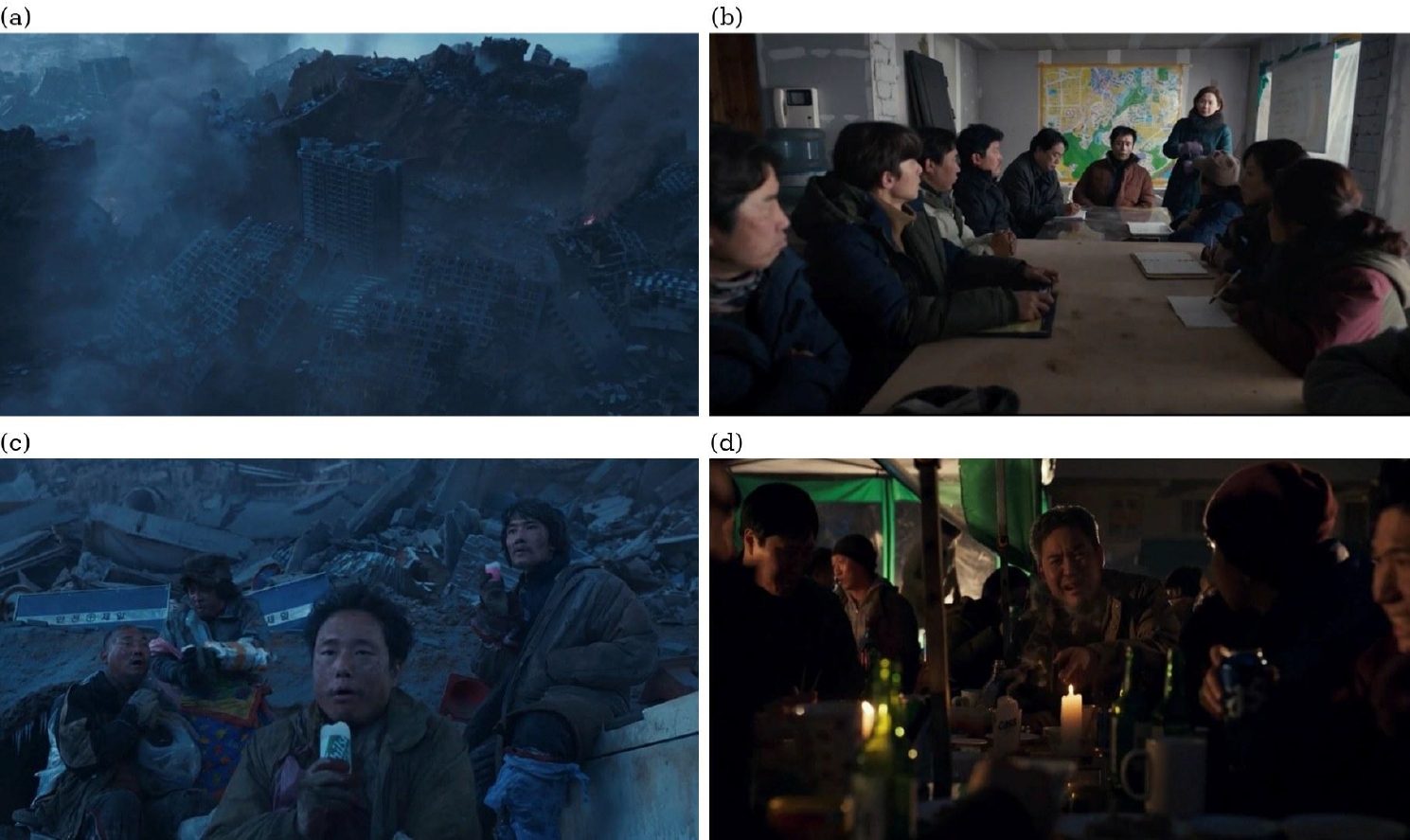
This article analyzes Um Tae-hwa’s Concrete Utopia (2023) through Yuri Lotman’s concepts of spatial modelling, boundary, and the semiosphere, to elucidate how the sign of the apartment constitutes dread within Korean society and to submit the discourse of K-dystopia to critical scrutiny. Reading that discourse as a mode of self-description reorganized under the conditions of transnational circulation and global-platform legibility after the global success of Squid Game (2021), the study attends to the local surplus that such naming fails to carry across, declining nonetheless to consign it to the untranslatable. Two movements compose the argument. Beyond the film, the specificity of the Korean apartment is bound to the discourse of K-dystopia so as to disclose a dread that circulation leaves untranslated; within the film, scene analysis traces the visual codification of interior against exterior, the graduated nullification of the other, and the closure of the boundary through the ossification of self-description. Diegetic exclusion and discursive subsumption prove to be a single semiotic operation nested at two magnitudes, a matryoshka isomorphism in which the recurring unease articulated in Korean viewer reviews may be read as registering the homology of the two. Untranslated dread, so situated, opens onto a productive site of reappropriation and emergence.
This essay proposes “newtro-punk” as a framework for understanding the Korean science fiction film Space Sweepers (2021) and its intervention into speculative fiction’s colonial genealogy. Newtro (Nyut’ŭro), a portmanteau of “new” and “retro,” focuses not nostalgic recreation but critical reinterpretation of past aesthetic forms to recuperate the visual vocabulary of colonial modernity and developmental hardship. Where silkpunk recovers precolonial material cultures, newtro-punk engages the traumatic textures of modernity itself, transforming worn surfaces produced under colonial extraction into speculative resources. Through analysis of the film’s remediation and citational practice, linguistic reappropriation, characterization of marginal subjectivity, and typographic aesthetics, this essay demonstrates how Space Sweepers enacts epistemic reappropriation by way of aesthetics, contesting established frameworks regarding what counts as properly futuristic through strategies that enact alternative valuations rather than merely arguing for them. The newtro-punk wager positions worn textures and vernacular particularity as legitimate materials for imagining futurity, demonstrating that futures imagined from positions of precarity possess validity equal to those imagined from positions of power.


 First
First Prev
Prev